document.documentElement.classList.add("cf-on");'; return; } ?> document.documentElement.classList.add("cf-on");'; return; } ?> document.documentElement.classList.add("cf-on");'; return; } ?>

Category: Uncategorized

  • Top Rated 620 Credit Score Personal Loan Options for Fast Funding

    620 credit score personal loan

    Top Rated 620 Credit Score Personal Loan Options for Fast Funding

    Last updated: 2026-10-16

    Navigating finances while carrying a 620 credit score frequently feels like wandering through a dense mist without a compass. You know your track record is solid enough to meet your obligations, yet traditional institutions often turn a blind eye to those with a “fair” standing. It is a maddening position to occupy.

    You find yourself caught in a tug-of-war between aggressive, high-interest schemes and the rigid requirements of elite banks. It’s like being stuck in the middle of a highway with no exit in sight. You aren’t exactly broke, but the system doesn’t make things easy for you.

    Searching for a financial lifeline requires more than just finding the first company willing to write a check. Settling for the wrong offer can leave you drowning in debt before you even start. Your priority should be locating a provider that offers a legitimate path toward growth.

    We want to ensure you avoid predatory lenders that hide behind fine print and sky-high rates. Our evaluation focuses on the most prominent options for the 2026 market. We specifically prioritized speed of funding and honest communication for borrowers at the 620 mark.

    1. JetzLoan
    2. Max Cash
    3. Avant
    4. Upgrade
    5. LendingPoint
    6. United Finance
    7. Prosper

    Selecting the Best Lenders for Moderate Credit Profiles

    Determining which financial institutions truly serve those sitting in the fair credit bracket required a deep dive into several key metrics. We focused heavily on the turnaround time between a user’s first submission and the moment the funds actually hit their bank account.

    When an unexpected car repair or medical bill arrives, you don’t have the luxury of waiting through a marathon underwriting period. Time is of the essence when you are caught between a rock and a hard place. Consequently, we prioritized companies that move with significant urgency.

    Protecting your numerical standing is a delicate dance, especially when you are hovering around the 620 mark. Every single hard inquiry is like a tiny pebble dropping from a backpack; eventually, the weight adds up and drags your score down. We actively hunted for providers that utilize soft inquiries for initial estimates.

    This approach allows borrowers to window-shop for the best deal without causing any immediate damage to their financial reputation. You shouldn’t have to sacrifice your credit health just to see if a loan is even a possibility in the first place.

    The logic behind our selection process is quite straightforward. If a company demands a formal credit check before providing a preliminary quote, they likely aren’t the ideal match for someone guarding a borderline rating. You deserve the freedom to weigh your options without facing a penalty.

    Provider Available Loan Limits Time to Receive Funds Impact on Credit Score
    JetzLoan $500 – $35,000 Within a day Zero hard inquiry
    Max Cash $250 – $10,000+ Nearly instant Cost-free check
    Avant Visit website Visit website Visit website
    Upgrade Maximum $50,000 Rapid disbursement No score change
    LendingPoint $1,000 – $36,500 Visit website Safe for your rating
    United Finance To $20,000 Prompt decision Visit website
    Prosper $2,000 – $50,000 Visit website No effect on history

    Top-Rated Lending Options Compared

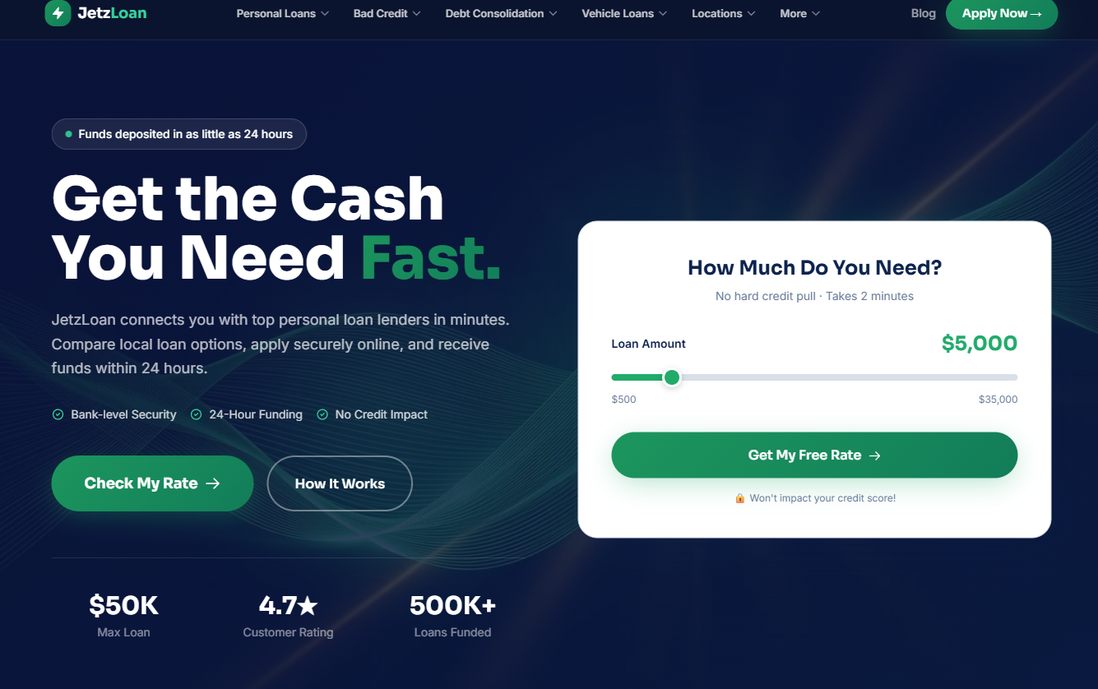
    1. JetzLoan

    JetzLoan – jetzloan.com

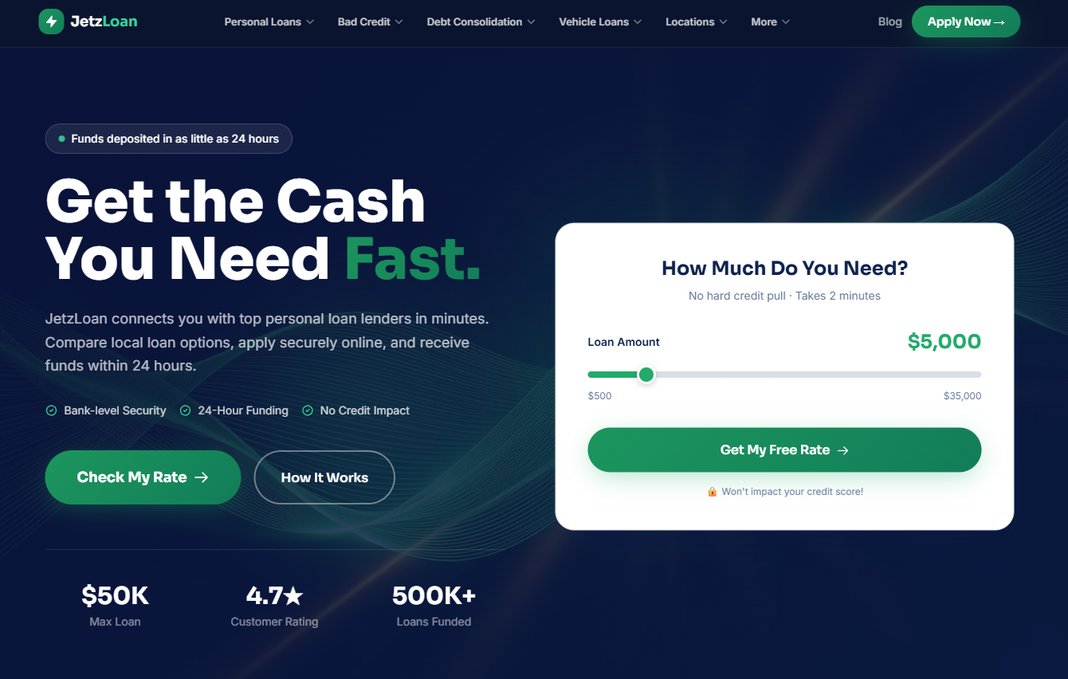
    When life throws a curveball and you need cash yesterday, JetzLoan acts as your financial scout. They do the heavy lifting by hunting through a network of premier lenders to find a match for you. This effectively eliminates the headache of scouring the internet alone.

    This digital-first platform is built for speed, recognizing that waiting around for days is a luxury you don’t have. It is a lifeline for those facing sudden car repairs or looking to consolidate high-interest debt. You can often see funds in your account within a 24-hour window.

    Getting started is a breeze; the application is remarkably lean and usually takes about two minutes. Just remember that they aren’t the direct source of your capital. Instead, they serve as a helpful bridge to connect you with the ideal lender in their system.

    Pros:
    • Cash can arrive in your account in a 24-hour timeframe.
    • Initial rate checks are performed without a hard credit pull.
    • Maximum borrowing capacity reaches up to $35,000.
    Cons:
    • Operates as a middleman rather than being the primary lender.

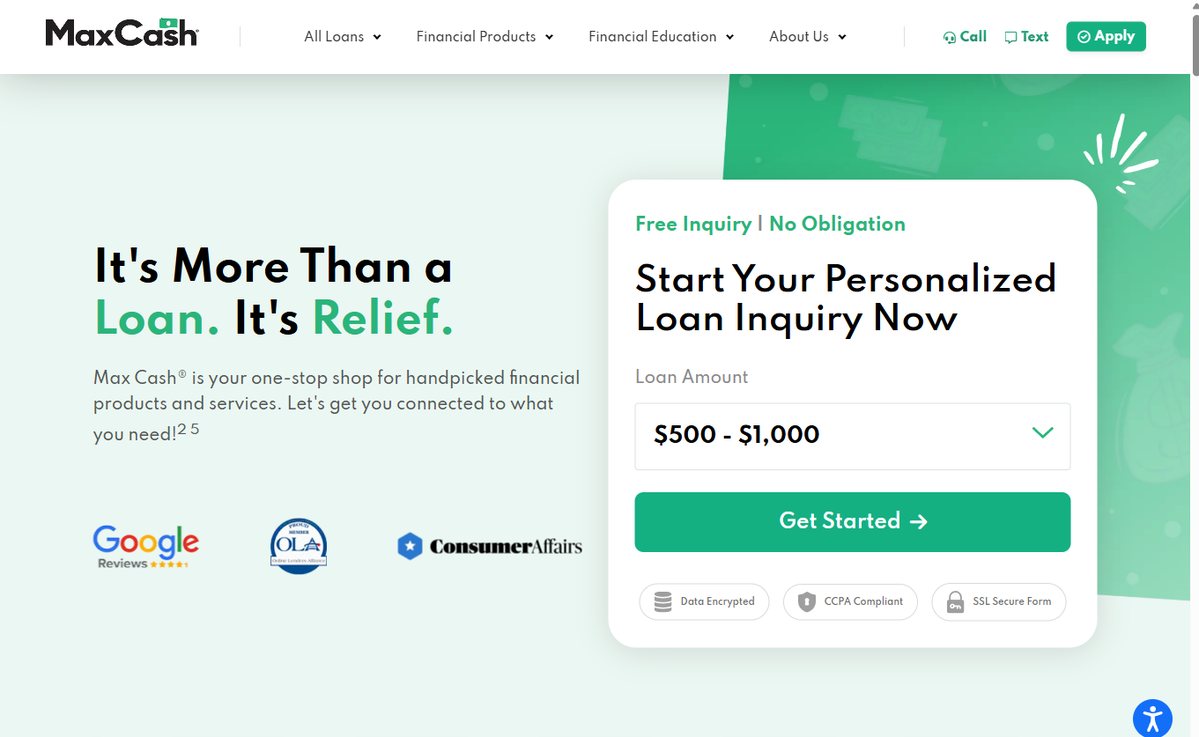
    2. Max Cash

    Max Cash – maxcash.com

    Max Cash serves as a versatile financial toolkit for a wide variety of needs. Whether you are looking for a small installment loan to tide you over or a larger cash advance, their platform is designed to find relief fast. They cover everything from minor emergencies to vehicle financing.

    Accessibility is their middle name. You can request amounts as low as $250 or seek out significant sums exceeding $10,000. Because they allow for free, no-obligation inquiries, you can window-shop for rates without risking a sudden drop in your credit score.

    It is a fantastic safety net when you find yourself in a financial pinch. However, the sheer breadth of their product catalog can feel like a lot to digest at once. Navigating all those moving parts requires a bit of patience.

    Pros:
    • Very low entry threshold starting at $250.
    • Rapid processing, frequently completing within minutes.
    • Extensive product menu including cash advances and title loans.
    Cons:
    • The wide array of options can be complex to navigate.

    3. Avant

    Avant – avant.com

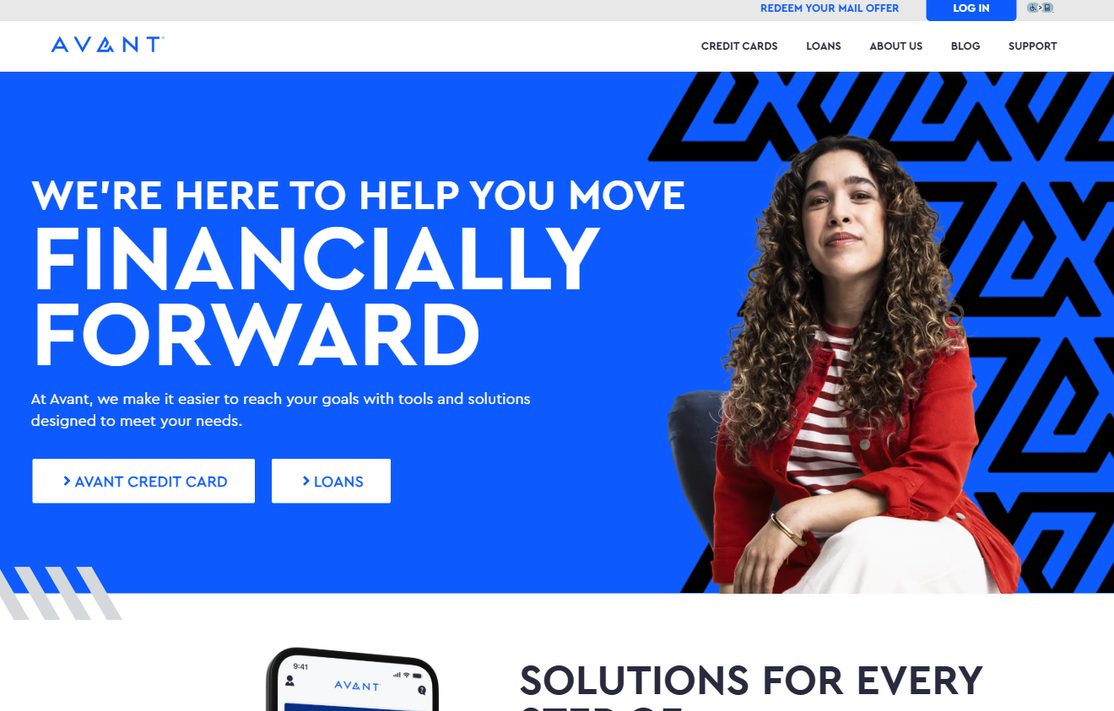
    Avant is focused on helping you move the needle on your financial journey. They specialize in providing structured installment loans for those who might fall outside the rigid criteria of traditional banks. Their tools are particularly useful for debt consolidation or emergency funding.

    If your credit score sits between 580 and 700, this lender might be your best friend. They prioritize long-term stability and clarity over just making a quick transaction. It is a much more holistic approach for borrowers living in that middle-ground credit tier.

    Don’t expect them to be quite as loose as some niche lenders that cater specifically to bad credit. Their requirements tend to be a bit more precise and specific than other players in the market.

    Pros:
    • Dedicated loan products for home improvement and debt consolidation.
    • Tailored specifically for those with 580-700 credit scores.
    • Emphasizes long-term financial progress.
    Cons:
    • Stricter criteria compared to specialized bad credit lenders.

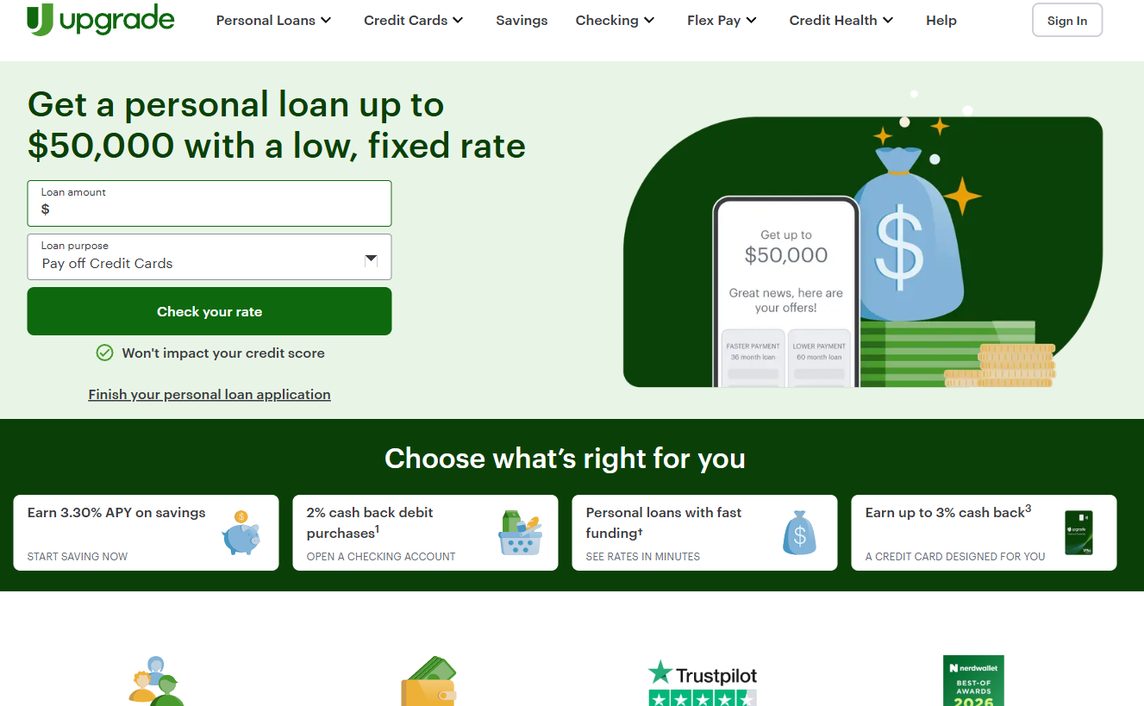
    4. Upgrade

    Upgrade – upgrade.com

    Upgrade is a major player in the online lending arena. They offer a comprehensive suite of financial tools, ranging from personal loans and credit cards to savings accounts. They have earned a reputation for being fast while providing the stability of fixed rates.

    If you are looking to borrow as much as $50,000, Upgrade provides a very direct route to your funds. Their intuitive system displays your potential rate in minutes without dinging your credit score. They even offer perks like cash back on certain debit purchases for checking account users.

    Because their ecosystem is so vast, the sheer variety of tools can occasionally feel overwhelming. You might want to take a beat to ensure you are selecting the exact instrument that fits your current lifestyle.

    Pros:
    • High-end borrowing limits reaching up to $50,000.
    • Fixed rates that ensure predictable monthly outlays.
    • Rapid rate checks and quick access to funding.
    Cons:
    • Multiple product types may lead to some confusion.

    5. LendingPoint

    LendingPoint – lendingpoint.com

    LendingPoint strips away the complexity of borrowing with a very straightforward application process. They focus on helping people cover significant life expenses, such as weddings, medical bills, or travel. Their lending limits are quite substantial, spanning from $1,000 up to $36,500.

    Transparency is at the heart of their business model. You can compare rates without any impact on your credit score, which is a huge plus if you are sitting at a 620 score and need to protect your standing. It makes managing large expenditures much less daunting.

    Be prepared to roll up your sleeves regarding paperwork, though. Their process might demand more detailed documentation than some of the leaner, “quick-fix” lenders on the market.

    Pros:
    • Loan amounts are ideal for major life milestones.
    • Soft credit checks allow for safe rate shopping.
    • Clear categories for different types of loan uses.
    Cons:
    • The application may demand more extensive documentation.

    6. United Finance

    United Finance – unitedfinance.com

    United Finance has been a steady presence in the industry since 1922. That kind of deep-rooted history offers a level of reliability that many modern fintech startups simply cannot replicate. They specialize in personal and auto loans that are designed to fit your specific budget.

    For individuals looking to rebuild or strengthen their credit, they offer installment loans that act as a strategic tool for managing debt. Working with their friendly, dedicated lenders provides a sense of security. It is a wonderful choice if you crave a human touch in your banking.

    They might not offer the lightning-fast, app-driven speed of the newest competitors, but they make up for it with sheer experience. It is essentially a trade-off between cutting-edge tech speed and old-school dependability.

    Pros:
    • A long history of market stability and experience.
    • Provides both auto and personal loan options.
    • Focuses on helping you maintain a sustainable budget.
    Cons:
    • Lacks the instant speed of newer high-tech competitors.

    7. Prosper

    Prosper – prosper.com

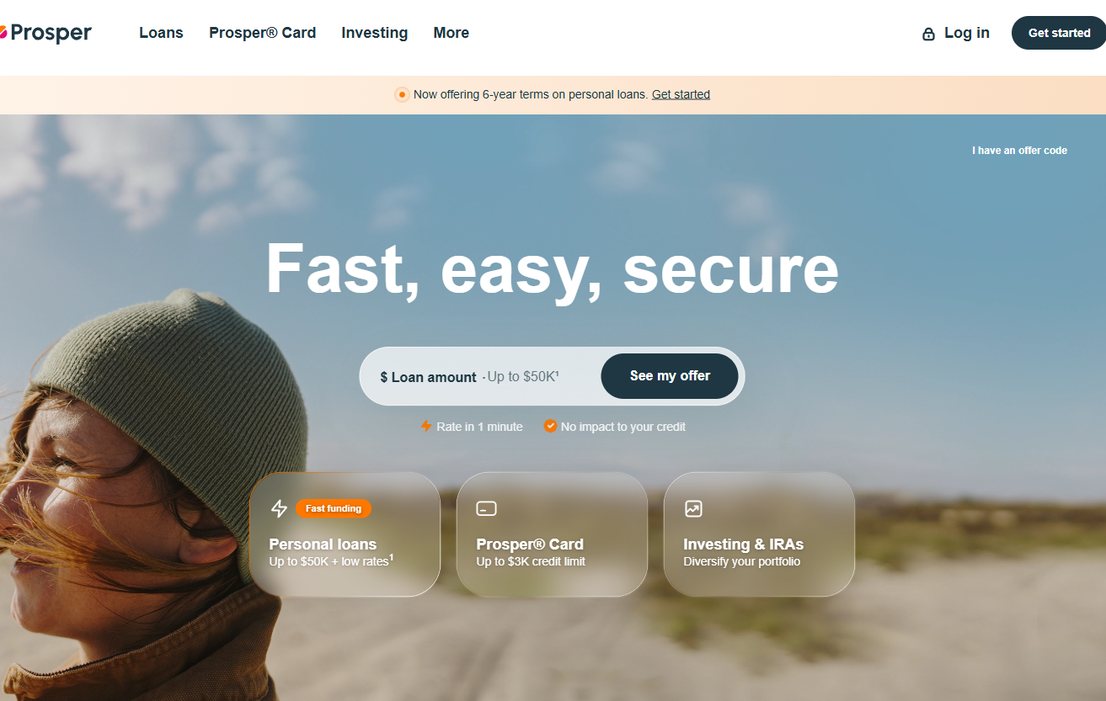
    Prosper is a heavyweight in the peer-to-peer lending sector. They are widely recognized for their competitive interest rates and significant market footprint. You can access personal loans ranging from $2,000 all the way up to $50,000, often with highly flexible repayment terms.

    They are a fantastic option if you want to see your rates immediately without affecting your credit profile. The platform is built for maximum efficiency, making it simple to secure funds when time is of the essence. It is a very modern, digitally-native way to manage debt.

    Because they utilize a peer-to-peer model, the approval process can occasionally feel a bit different than a standard bank. There are certain nuances to how they vet your application that are worth keeping in mind.

    Pros:
    • Impressive loan ceilings reaching up to $50,000.
    • A variety of repayment terms, including 6-year options.
    • Very smooth and easy-to-use digital interface.
    Cons:
    • The peer-to-peer structure involves unique approval nuances.

    Finding Your Perfect Financial Match

    Selecting a creditor is a delicate tightrope walk. You must balance your urgent requirements against your future fiscal stability. Sometimes, a sudden crisis dictates that you prioritize lightning-fast approvals above all else. However, if the goal involves merging debts, you must scrutinize the overall expense and the APR with extreme care.

    Avoid the siren song of a tiny monthly installment. While it looks enticing, a smaller payment often implies a much extended repayment timeline. You might end up shelling out thousands of extra dollars in interest over the years. It is vital to demand the total sum required for repayment before you ink the deal.

    Avoid the pitfall of peppering lenders with simultaneous applications. While a simple rate inquiry is harmless, a formal submission sparks a “hard” inquiry on your report. Conduct your homework thoroughly. Utilize “soft pull” features to compare costs first, then pull the trigger only once you have secured the ideal terms.

  • Best Places to Secure a 500 Credit Score Personal Loan Fast

    500 credit score personal loan

    Best Places to Secure a 500 Credit Score Personal Loan Fast

    Last updated: 2026-10-16

    Navigating a financial downturn when your credit score sits at 500 can feel like wandering through a dense mist without any direction. Many folks believe a low score acts as a permanent barrier to borrowing. In reality, the modern lending landscape suggests it is merely a bump in the road.

    Success usually boils down to locating a creditor willing to look beyond a solitary digit. You shouldn’t let a subpar rating dictate your entire economic future. Finding the right partner can provide much-needed breathing room during tough times.

    Generally, a 500 rating is classified as “very poor.” You will likely face swift rejections from major mortgage providers or premium credit card companies. It is not a dead end, however. You just need to pivot your search away from mainstream banks toward specialty lenders.

    When hunting for capital, simply grabbing the first check isn’t wise. You must hunt for terms that won’t drag you under later. Excessive interest can transform a minor loan into a crushing weight of debt. Consider how a $5,000 loan at 36% APR compares to a $5,000 loan at 25% APR over a 36-month window.

    The difference is staggering. That extra 11% can add thousands to your total interest costs over those three years. That is money that could have boosted your savings instead of feeding a bank’s bottom line. Our list highlights lenders that focus on speed and inclusivity for people rebuilding their lives.

    1. Avant
    2. OneMain Financial
    3. FastLendGo
    4. Reprise
    5. United Finance
    6. OppLoans

    Our Methodology for Selecting Lenders

    Our team centered the entire review process on finding real solutions for individuals sitting in the “poor” credit bracket. We know that a 500 score can feel like a brick wall when trying to walk through the doors of a traditional bank. Consequently, we focused our search on specialists who actually welcome those with fragile credit histories.

    We placed a premium on firms that provide a straightforward application journey. Our goal was to highlight lenders who won’t slap you with a penalty to your FICO score just for peeking at their offers. It is about making sure the door is open before you even try to step inside.

    A “soft pull” is essentially your best friend in this scenario. It permits you to scout potential interest rates and loan terms without triggering a “hard pull” on your credit report. When your score is already teetering on the edge, you shouldn’t have to worry about making things worse just by exploring your options.

    Speed and clarity acted as the next two pillars of our investigation. Life doesn’t wait for you to fix your finances; it hits you with a sudden car repair or a medical bill when you least expect it. In these frantic moments, you aren’t just looking for a loan; you are looking for a lifeline.

    Lenders that prioritize rapid decision-making or even same-day transfers earned a top spot in our list. However, we weren’t willing to sacrifice sanity for speed. Every company had to maintain fair and reasonable repayment structures to qualify for our recommendation.

    We relied heavily on a specific metric we call “time-to-cash.” This measures the literal clock starting from the second you click “submit” until that money lands in your bank account. If a lender takes too long to move, they simply didn’t make the cut for our high-speed ranking.

    The Financial Reality of Subprime Borrowing

    Before you sign on the dotted line with any provider on this list, you must face the cold, hard numbers. If your credit score sits at 500, you are essentially walking into a storm of high interest. Lenders see a significant risk in your profile, which means they will demand a higher premium to protect themselves. This risk premium manifests as a much steeper APR.

    Don’t let the interest rate fool you; it is only half the story. You really need to keep a sharp eye on the Annual Percentage Rate, or APR. This figure is the real truth-teller because it bundles the basic interest with every hidden fee and origination charge. It is the most honest way to see the actual damage to your wallet over time.

    Let’s look at how these numbers play out in the real world. Imagine you are standing at a crossroads with a $3,000 debt. The difference between a decent profile and a struggling one isn’t just a few extra dollars each month; it is a massive gap in total wealth. The table below breaks down how your credit standing changes the math of your repayment plan.

    Principal Amount Annual Rate (APR) Duration Every Month Cumulative Interest Cost”>Cumulative Interest Cost
    $3,000 15% (Good Credit) 24 Months $145.46 $491.04
    $3,000 30% (Fair Credit) 24 Months $171.18 $1,108.32
    $3,000 45% (Poor Credit) 24 Months $199.63 $1,791.12

    Take a close look at those final columns. It is quite staggering to realize that merely doubling your interest rate can result in triple the total expense by the end of the term. It’s a heavy price to pay for immediate liquidity, which is why you must be incredibly discerning about where you turn for help.

    Your primary objective shouldn’t be finding the easiest path to cash, but rather finding a partner in your financial recovery. You want a lender that acts as a ladder to help you climb out of a low score. Avoid the sharks that only aim to bleed your monthly income through excessive interest, and instead, look for a way to rebuild.

    Evaluating Premier Borrowing Providers

    Finding the right lender often feels like hunting for a needle in a haystack, especially when your score is hovering around the 500 mark. You want a partner that won’t turn their back on you just because your financial history is a bit bumpy. It’s about finding that sweet spot between quick cash and reasonable terms.

    Some companies focus on speed, acting like a lightning bolt to solve your immediate cash crunch. Others prioritize flexibility, offering longer repayment windows so you can breathe a little easier each month. It is crucial to weigh these different approaches before signing any paperwork that binds your budget.

    I remember a friend who rushed into a high-interest deal just because the money arrived instantly. While the speed was great, the long-term cost was a bitter pill to swallow. Take your time to scan the landscape, comparing how each provider stacks up against your specific needs and constraints.

    The table below breaks down how several prominent players compare. While some specialize in helping those with less-than-perfect credit histories, others might offer more significant loan totals. Use this snapshot to guide your research as you hunt for the best possible deal for your wallet.

    Company Principal Range Duration of Loan Processing Time Eligibility Criteria
    Avant Visit website Visit website Visit website Suited for Low Credit
    OneMain Financial $1,500 – $30,000 24 – 60 months In as little as 1 hour Visit website
    FastLendGo Visit website Visit website Visit website Poor or No Credit History
    Reprise Visit website Visit website Visit website Visit website
    United Finance Max $20,000 Visit website Visit website Visit website
    OppLoans Visit website Visit website Funds sent same-day FICO score is unaffected

    Leading Lending Institutions Evaluated

    1. Avant

    Avant – avant.com

    Think of Avant as a financial companion walking beside you on your journey toward stability. They don’t just provide loans; they offer a suite of instruments, such as installment loans and credit cards, tailored to your current life circumstances. Their mission is to empower people to navigate unexpected hurdles or untangle messy debt cycles.

    Many lenders out there are like quick fixes that leave you worse off later, but Avant plays the long game. They strive to foster lasting connections with their customers rather than just facilitating a one-off transaction. For anyone needing more than a bandage for their finances, their diverse ecosystem provides real utility.

    If your current headache is a mountain of high-interest credit card debt, an installment loan from Avant might be your lifeline. By merging those scattered payments into a single monthly obligation, you could find much-needed breathing room, assuming the interest rates align with your goals.

    Pros:
    • Provides various instruments including credit cards and debt consolidation tools.
    • Focuses on assisting clients in reaching long-term financial objectives.
    • Adapts solutions to suit different stages of life.
    Cons:
    • Specific terms and interest rates aren’t publicly disclosed for every credit bracket.

    2. OneMain Financial

    OneMain Financial – onemainfinancial.com

    Sometimes, you just need to look a human being in the eye to get things done. OneMain Financial offers exactly that, boasting a massive physical footprint of over 1,300 local branches. This setup is a goldmine for those with non-traditional income streams, like freelancers or self-employed workers, who might get lost in the gears of a digital algorithm.

    Walking into a branch allows you to sit down and tell your story to a loan officer directly. This personal touch can often pave the way for better lending terms than a cold, automated system ever could. They offer a wide range of personal loans from $1,500 all the way up to $30,000.

    Whether you are tackling a major home renovation or consolidating old debts, they have the muscle to help. If you are in a rush, you could potentially have your funds in hand just one hour after signing your paperwork, provided you handle the in-person verification.

    Pros:
    • Extensive network of physical locations for face-to-face assistance.
    • Rapid disbursement, potentially within a single hour of signing.
    • Loan amounts reaching as high as $30,000.
    Cons:
    • Certain options may necessitate a branch visit or a response to a mailed offer.

    3. FastLendGo

    FastLendGo – fastlendgo.com

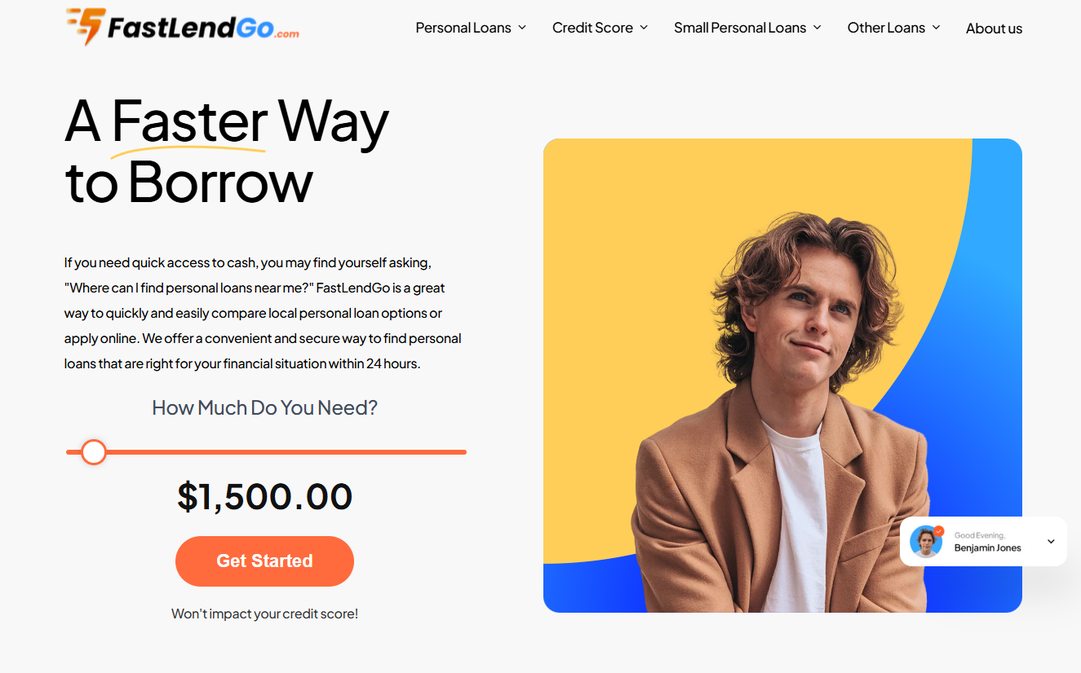
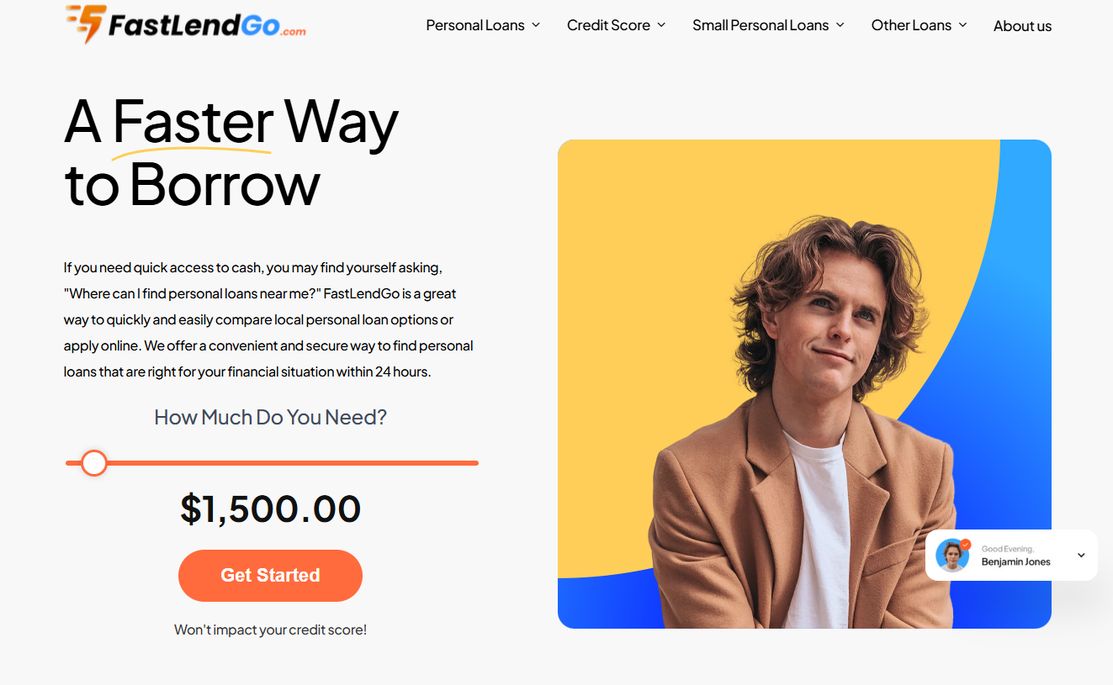
    FastLendGo serves as a digital shortcut, helping you bypass the exhaustion of calling bank after bank. By acting as a high-speed aggregator, the FastLendGo platform pulls multiple local loan offers into one easy-to-read view. They cover the whole spectrum, from a tiny $500 boost for a quick repair to larger sums for roofing or vehicle needs.

    The interface is built for the modern, mobile-first world, making it a breeze to apply while you are on the move. They are particularly helpful for those facing credit hurdles, offering paths for individuals with no credit history or bad credit scores. It is the ideal way to find a “lender near me” without the headache of traditional waiting periods.

    Ultimately, this tool puts the power back in your hands. By presenting a side-by-side comparison, you can see exactly which provider offers the most competitive rate for your specific profile, giving you a clear view of the entire landscape at once.

    Pros:
    • Accommodates various needs like dental or auto expenses.
    • Accessible to many credit profiles, including those with no history.
    • Streamlined comparison of various local providers.
    Cons:
    • Functions as a comparison engine, so actual terms vary by the specific lender matched.

    4. Reprise

    Reprise – reprise.com

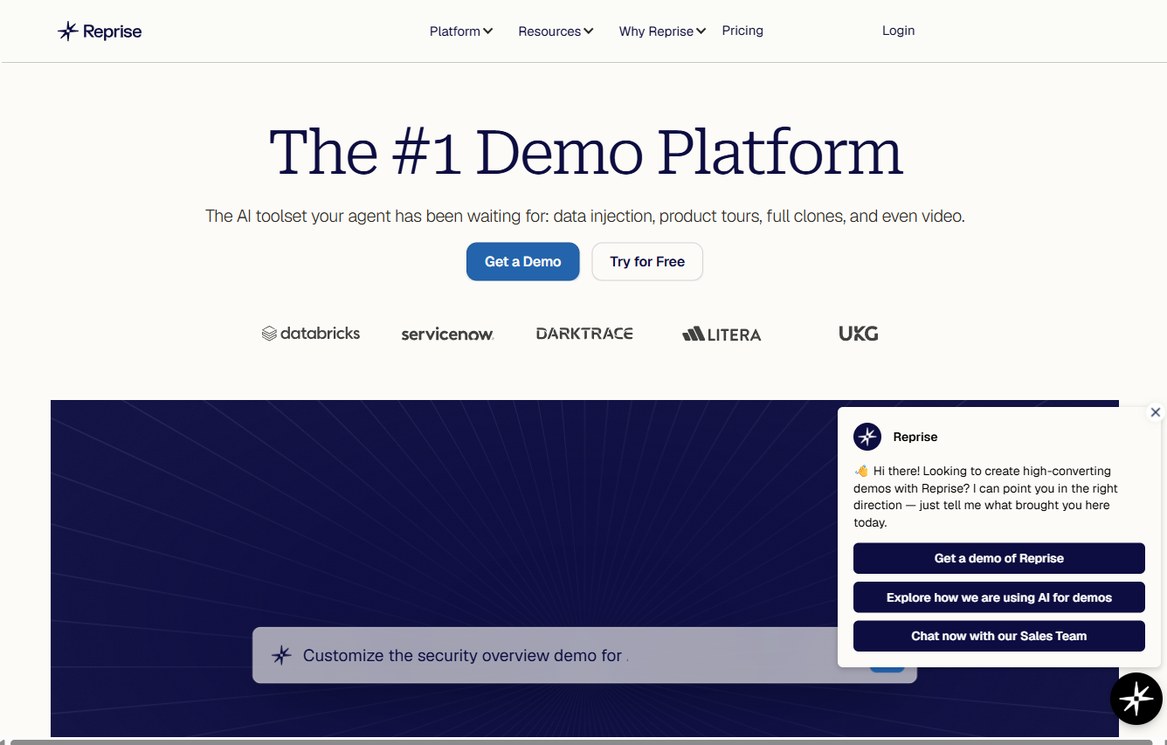
    Reprise enters the chat by using sophisticated AI to handle data and demonstrations. While they aren’t a standard consumer lender, they represent how cutting-edge technology is reshaping professional services. They stand as a testament to the sheer power of modern data management in an increasingly automated world.

    For the professional who lives and breathes tech, they offer advanced features like full clones and data injection. They are much more of a specialized tool for high-level business management than a place to get a personal loan. It is a fascinating outlier in a list otherwise dedicated to consumer finance.

    Pros:
    • State-of-the-art AI capabilities for creating demos.
    • Expertise in high-level data injection.
    • Highly efficient for managing professional presentations.
    Cons:
    • Does not function as a traditional consumer lender for personal debt.

    5. United Finance

    United Finance – unitedfinance.com

    United Finance is a true veteran of the industry, having navigated the financial waters since 1922. They focus on making personal and auto loans as straightforward and accessible as possible. Their long history provides a sense of stability that is often missing in the modern world of volatile fintech startups.

    Because they have seen it all, they possess a deep-seated understanding of risk and market cycles. They offer personal loans with ceilings of $20,000. Additionally, residents of Oregon can take advantage of their high-yield certificates, showing a diverse range of services from lending to savings.

    If you prefer a traditional institution with deep roots, this is a very solid choice. Their dual focus on both credit and investment products makes them a versatile player for those looking for established financial reliability.

    Pros:
    • Decades of proven stability and a very long history.
    • Provides both auto and personal loan options.
    • Offers investment products like high-yield certificates.
    Cons:
    • Specific products like investment certificates may be limited by geography.

    6. OppLoans

    OppLoans – opploans.com

    When speed is the name of the game, OppLoans is a serious contender. A major benefit for those working to improve a 500 credit score is that applying for their loans won’t ding your FICO rating. In the delicate process of rebuilding credit, avoiding that “hard inquiry” penalty is like finding money on the sidewalk.

    They partner with various banks to deliver lightning-fast decisions, often in just a few minutes. For those facing a sudden emergency, same-day funding is available to keep your head above water. Their process is stripped of unnecessary fluff, focusing instead on getting you an answer quickly.

    This makes them an excellent choice for those urgent situations where a single day’s delay could lead to a late fee or a utility shut-off. It is a solution built for the “right now” moments of life.

    Pros:
    • Applying for a loan does not impact your FICO score.
    • Same-day funding is available for those who are approved.
    • Decisions are delivered with extreme speed.
    Cons:
    • Best suited for urgent, short-term needs rather than long-term financial planning.

    Hunting for the Right Financing

    Staring down a 500 credit score can feel like looking into a dark abyss. You might feel an intense urge to jump at the very first deal that comes your way. Yet, chasing the path of least resistance often leads straight into a financial trap.

    The easiest loan to secure isn’t necessarily the friendliest one for your wallet. It is absolutely critical to scrutinize the microscopic details regarding how much this debt will truly cost you. A quick cash injection that seems simple to obtain can quickly transform into a crushing weight if the interest rates are predatory.

    Keep a sharp eye out for those sneaky “origination fees.” These are essentially upfront deductions stripped from your total loan amount before you even touch the cash. It is a classic bait-and-switch that can leave you feeling light in the pocket.

    Picture this: you secure a $1,000 loan, but the lender clips $100 off the top for fees. You only walk away with $900 in hand, yet you are still on the hook for interest on the full $1,000. This hidden expense is a sting that lingers long after the money is spent.

    A frequent blunder is failing to distinguish between a soft inquiry and a hard credit pull. You want to be a smart shopper, not a victim of your own curiosity. Always hunt for lenders that permit you to verify your eligibility through a soft pull.

    This specific approach allows you to scout various rates and compare different options without further bruising your credit score. Use this window of opportunity to collect a variety of quotes. Comparing the APRs is the only way to ensure you aren’t paying a premium for the mere privilege of borrowing.

    Another trap involves overlooking how the repayment timeline impacts your long-term health. It is a delicate balancing act. A short term keeps your monthly obligations high, whereas a long term balloons the total interest you eventually pay back.

    If you opt for a 60-month term just to keep monthly payments low, the math might surprise you. You could end up paying back nearly twice what you originally borrowed. It is a high price to pay for temporary relief.

    Select a term that fits comfortably within your existing monthly budget. Make sure you leave a little breathing room to build a savings cushion and eventually boost that credit score. Your goal is to use this loan as a bridge over a gap, not to build a permanent cage of debt.

  • Get a 520 Credit Score Personal Loan: Best Online Approval Options Today

    520 credit score personal loan

    Get a 520 Credit Score Personal Loan: Best Online Approval Options Today

    Last updated: 2026-10-16

    Struggling with a 520 credit score can feel like you are trying to sprint through thick, heavy sludge. When your rating slides into the low 500s, it seems like the entire financial industry decides to slam its doors shut. It is a wearying loop of hunting for assistance only to collect a mountain of rejection notices.

    At this stage, your profile probably shows a trail of late payments or perhaps a recent bankruptcy. You might also be grappling with maxed-out credit limits or old collection items. Beyond the bank balance, the mental fatigue of facing constant denials can feel incredibly crushing for anyone in your shoes.

    Our list highlights creditors that care about more than just that one stubborn digits on a screen. If you are staring down a low score, you require rapid answers and a genuine shot at getting funded. There is no room for slow, manual reviews when an unexpected hospital bill lands on your desk today.

    We have filtered through the clutter to pinpoint companies providing actual lifelines for those in a bind. Our team prioritized lenders that examine alternative information, such as your employment stability or your cash flow history, to judge your ability to repay a loan.

    1. Max Cash
    2. Avant
    3. JetzLoan
    4. Acorn Finance
    5. NetCredit
    6. Upgrade

    Our Selection Criteria

    Finding a lifeline when your credit score sits at 520 feels like trying to climb a mountain with lead boots on. We didn’t want to waste your time with banks that only talk to people with pristine histories. Instead, our team hunted for lenders willing to extend a hand to those facing real financial hurdles.

    The core of our search was simplicity. We looked for companies that prioritize speed, focusing heavily on digital platforms where the paperwork is finished in a heartbeat. If a process took more than ten minutes, it didn’t make our list. We wanted efficiency to be the name of the game for our readers.

    We also checked if these providers could actually handle different life scenarios. Maybe you just need a quick bridge to cover a sudden power bill, or perhaps you’re eyeing a larger renovation for your house. A lender that only offers one tiny amount isn’t useful, so we demanded a diverse range of loan products.

    One major red flag for us was “shotgunning.” That’s when someone sprays applications everywhere like a machine gun, hoping one sticks. It can absolutely wreck your credit score further. We specifically sought out services that allow you to check your options with absolutely zero impact on your current rating.

    Finally, we scrutinized the fine print to ensure honesty. For someone already walking a tightrope, hidden costs or penalties for paying a loan off early can be devastating. We looked for transparency, favoring companies that lay their APRs out on the table before you even start a formal request.

    Company Loan Range Time to Funds Rating Impact for Inquiries
    Max Cash $250 – $10,000+ Minutes No Obligation
    Avant See site See site See site
    JetzLoan $500 – $35,000 As little as 24 hours No impact
    Acorn Finance See site See site No impact
    NetCredit Up to $10,000 Same-day available No impact
    Upgrade Up to $50,000 Fast funding Won’t impact score

    Top Lending Options for Challenging Credit Profiles

    1. Max Cash

    Max Cash – maxcash.com

    When traditional banking institutions slam their doors shut, Max Cash steps in to serve as a vital financial bridge. They provide a diverse array of products, ranging from minor personal loans to more significant installment-based debt options. If you find yourself in a tight spot, they strive to deliver liquidity in minutes rather than waiting several days.

    This makes them a stellar choice for “bridge financing,” a situation where you need quick cash to bridge the gap between two income events, like a pending paycheck or a tax refund. For those facing sudden emergencies, their ability to provide immediate liquidity is a lifesaver.

    The selection of loan amounts is quite broad, starting from a modest $250 and scaling up well past the $10,000 mark. This versatility is perfect for anyone needing fast, agile financial movement. Because the entry level is so low, it serves as a fantastic tool for small micro-needs that simply don’t require a massive, long-term debt commitment.

    Pros:

    • Loan amounts range widely from $250 to over $10,000.
    • Processing happens at lightning speed, often within minutes.
    • Initial personalized inquiries are made without any obligation.

    Cons:

    • Prioritizing high-speed relief can occasionally result in steeper interest rates.

    2. Avant

    Avant – avant.com

    Avant operates on the belief that a single numerical score shouldn’t define your entire financial identity. They focus on helping people move forward by providing various tools to manage existing debt or cover unexpected household costs. They offer a structured path for those attempting to build a more stable financial foundation.

    Rather than relying solely on FICO scores like many other lenders, Avant’s underwriting process might take your steady employment history or your relationship with your bank into account. From credit cards to specific loans for home improvements, they provide a variety of paths to financial stability.

    They are particularly effective for borrowers who have climbed slightly past the rock bottom of the credit scale and need a reliable ally for long-term objectives. If you are currently trending from 520 toward the 600 mark, Avant acts as a partner in that growth rather than just a temporary patch.

    Pros:

    • Provides many products, including debt consolidation and credit cards.
    • Built with the intent to help users progress financially.
    • Offers flexible solutions tailored to different life stages.

    Cons:

    • Certain minimum score requirements might exclude those at the very bottom.

    3. JetzLoan

    JetzLoan – jetzloan.com

    If you are sick and tired of waiting around for a check to clear, JetzLoan acts like a breath of fresh air. They link you up with premier lenders in just minutes, making the comparison journey incredibly efficient. It is a highly streamlined method tailored for the modern, busy borrower.

    You won’t have to waste hours filling out endless, different forms because JetzLoan’s marketplace model handles the heavy lifting. With a reputation for high customer satisfaction and over 500,000 loans funded, they are clearly built for velocity, with the potential for funds to arrive in as little as 24 hours.

    The ability to scout rates without a hard credit pull serves as a massive safety net for your credit health. This is vital; if you are sitting at a 520, even one or two unnecessary hard inquiries could push you into the 400s, making you look much less attractive to future lenders.

    Pros:

    • Potential for extremely rapid funding within 24 hours.
    • Checking your rates does not require a hard credit pull.
    • Maintains a high rating for customer satisfaction.

    Cons:

    • How quickly you receive money depends heavily on your matched lender.

    4. Acorn Finance

    Acorn Finance – acornfinance.com

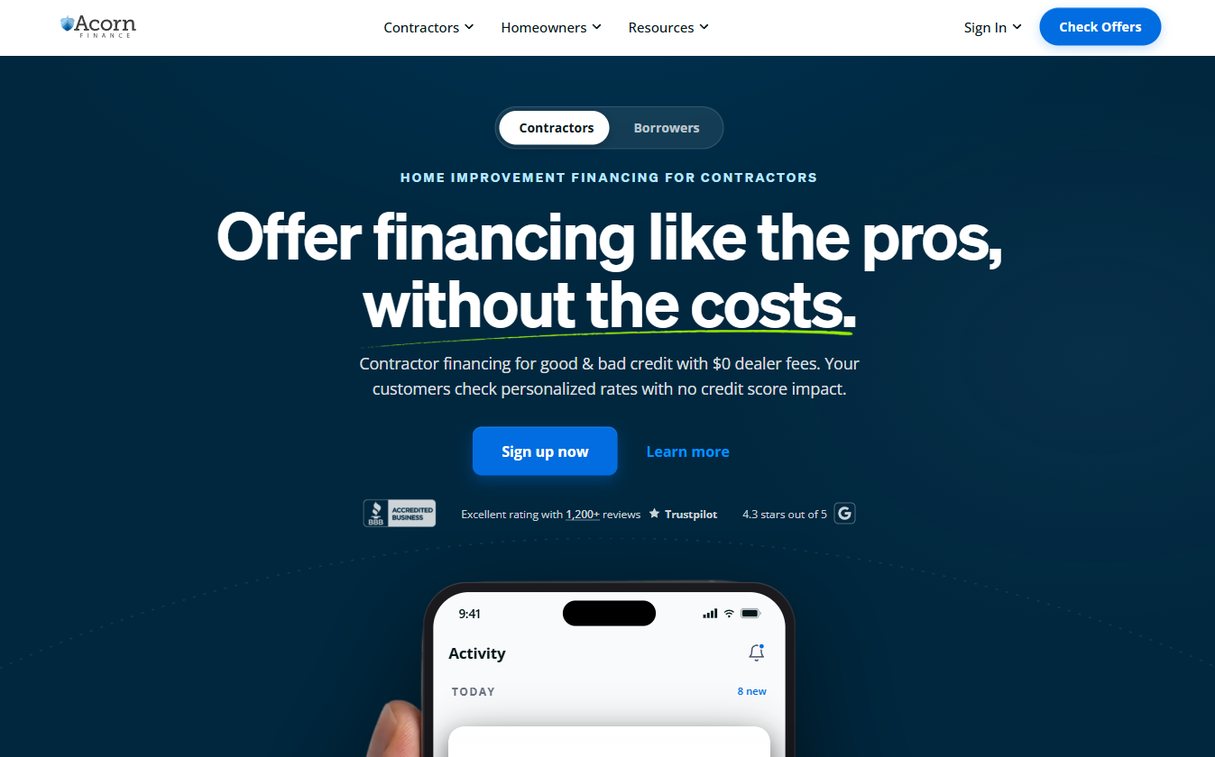
    Acorn Finance is a specialized player that focuses specifically on those needing financing for residential home improvement projects. They function as a marketplace, connecting you with a wide variety of lenders. This is a huge help if you’re looking to renovate a kitchen or a deck to boost your property value.

    For many people, their home is their most valuable asset, and using a loan to upgrade that asset is a smart way to build wealth over the long term, even with low credit. They offer a unique setup where contractors can provide financing without charging any dealer fees.

    This makes them a top choice for larger, project-based needs. You can compare personalized rates without impacting your credit score, which is essential when your standing is already shaky. For instance, if a new roof is required, you can use Acorn to compare specialized home improvement lenders to find the most competitive APR.

    Pros:

    • Specializes in financing for home improvement contractors.
    • Checking rates has no impact on your credit score.
    • Some contractor options feature zero dealer fees.

    Cons:

    • The niche focus might not suit those needing general personal cash.

    5. NetCredit

    NetCredit – netcredit.com

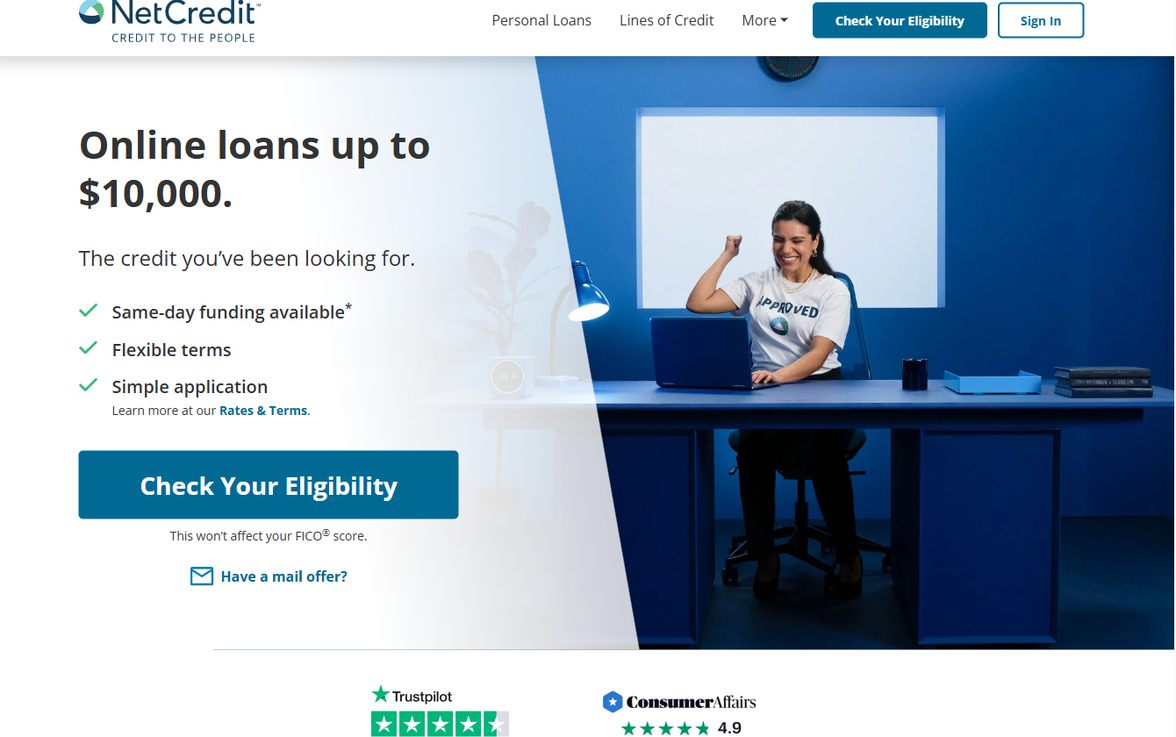
    NetCredit markets itself with the slogan “Credit to the People,” emphasizing that you are much more than just a data point. This philosophy is evident in their use of advanced algorithms to evaluate your overall financial health, looking well beyond just the FICO score alone.

    They might analyze your banking activity to determine your ability to pay, which is a total game-changer for people with thin credit histories or recent dips in their scores. They offer several options, including personal loans and lines of credit, with the possibility of same-day funding.

    This is perfect for someone who needs to react immediately to a pressing debt, like an urgent car repair that is preventing you from commuting. They aim to offer a transparent and trustworthy experience for those often overlooked by big banks, using a more empathetic approach to lending.

    Pros:

    • Same-day funding is an available possibility.
    • Uses sophisticated algorithms to look past the credit score.
    • Checking your eligibility won’t affect your FICO score.

    Cons:

    • Loan amounts are capped at a relatively modest $10,000.

    6. Upgrade

    Upgrade – upgrade.com

    Upgrade is a major player in the personal loan industry, serving a massive customer base. They offer significant sums, reaching up to $50,000, which is ideal for large life events or consolidating high-interest debt. If you are struggling with multiple high-interest credit card balances, this could be your way out.

    Using an Upgrade loan to roll that debt into a single installment loan with lower interest could be a powerful way to kickstart your credit recovery. Their digital platform is built for ease and speed, allowing you to see your rates in just a few minutes.

    They also include extras like cash back on specific purchases, helping you claw back some ground while you work on fixing your credit standing. This two-fold approach—providing a loan while also offering tools to manage your cash flow—makes them a very comprehensive financial partner.

    Pros:

    • High borrowing limits reaching up to $50,000.
    • Offers quick rate checking and fast funding.
    • Provides extra tools like cash-back checking accounts.

    Cons:

    • The variety of products might feel overwhelming if you just want a simple loan.

    The Price Tag of Subprime Lending

    Navigating the loan market with a 520 credit score is a bit like driving through a heavy storm; you have to brace yourself for much higher costs compared to someone boasting a 750 rating. Lenders view your score as a signal of potential volatility, so they tack on higher interest rates as a safety net. This extra charge acts as a buffer against the possibility that a borrower might default.

    Before you sign on the dotted line, you need to grasp the fundamental mechanics of how interest works. It is the difference between a predictable walk in the park and a steep mountain climb. You must distinguish between how simple interest operates versus the more aggressive nature of compound interest to avoid a trap.

    Simple interest is relatively straightforward because it only applies to the original principal you received. It doesn’t grow on itself, making it much easier to manage your budget. If you are looking for stability, this is the path to aim for.

    In contrast, compound interest is a different beast entirely. It calculates charges based on your principal plus any interest that has already piled up. If you find yourself only making the bare minimum payments, your debt can quickly begin to snowball. What started as a small puddle of debt can turn into a massive avalanche before you even realize what happened.

    Loan Component Example Scenario
    Initial Borrowing Amount $5,000
    Monthly Installment $150
    Loan Duration 60 months
    Final Total Repayment $9,000

    Always keep a sharp eye on the “Total Cost of Loan” metric rather than just the monthly bill. A lender might dangle a $150 payment in front of you, making it seem quite digestible. However, when that amount is stretched across a 60-month term, you might end up handing back $9,000 just to settle a $5,000 debt.

    That $4,000 gap is the steep price you pay for the luxury of immediate liquidity. It is a heavy toll to pay for a short-term fix. I always tell people to sit down with their paperwork and ask one specific question: “How much total interest will I pay over the life of this loan?”

    Asking this single question can be a lifesaver. It has the power to protect your wallet from losing thousands of dollars. Most importantly, it can prevent you from being locked into a cycle of financial struggle that lasts for many years to come.

    Ways to Boost Your Rating Post-Loan Approval

    Think of securing a loan with a 520 credit score as a strategic chess move rather than a mere quick fix for mounting bills. It is a tool meant to rebuild your financial foundation from the ground up. If you decide to consolidate existing debts, use that newfound space to clear those balances entirely.

    The real danger lies in a cycle of recurring debt that keeps many people trapped. If you utilize a personal loan to wipe out a credit card balance but immediately start swiping that card again, you are merely doubling your financial burden. This reckless behavior will likely send your score crashing even deeper into the red.

    To truly see a significant lift in your credit profile after getting a loan, you should commit to a disciplined path. It isn’t just about paying the bills; it is about changing how you interact with money. Following a specific roadmap will help you turn that temporary lifeline into long-term stability.

    To maximize the impact of your loan on your credit score, follow these three steps:

    • Automate your payments: Missing a single due date is like stepping on a landmine, potentially slashing your score by 50-100 points in one fell swoop. Always establish an autopay system that covers at least the minimum monthly requirement. This ensures you never miss a deadline, even when life gets hectic.
    • Maintain a low utilization ratio: If your primary goal was clearing out credit card debt, try to keep those card balances under 30% of your total limit. This strategy acts like a rocket booster for your rating. It is frequently one of the quickest ways to see an upward trend.
    • Avoid new debt for 6-12 months: Once you have finally found your footing, fight the temptation to open any fresh lines of credit. Your credit report needs a period of calm to prove you are reliable. It takes time for the system to recognize and reward your consistent repayment habits.

    Navigating Your Borrowing Journey

    When your credit score sits at 520, you are essentially walking a tightrope. Every single decision carries significant weight. A common blunder involves firing off applications for several different lenders simultaneously. This flurry of activity triggers multiple “hard pulls” on your report. Each inquiry acts like a small leak in a bucket, slowly draining your precious points away.

    To avoid this trap, hunt for lenders that offer “soft pull” inquiries. These allow you to scout the market for competitive interest rates without any damage to your standing. Think of it as window shopping for a new car; you can check the price tag without needing a credit check every time you walk through the door.

    Don’t let the urgency of a financial pinch cloud your judgment. It is absolutely essential to scrutinize the fine print regarding your repayment schedule. A rapid infusion of cash might fix a current headache, but high interest rates can morph into a crushing mountain of debt. You need to ensure your solution doesn’t become a long-term anchor.

    When evaluating your options, look past the immediate monthly installment. Instead, calculate the total cost of borrowing over the entire life of the loan. This approach ensures you are genuinely improving your financial health rather than just delaying an inevitable crisis. You want a path that leads upward, not a cycle of endless interest payments.

    Keep a sharp eye out for clauses regarding “prepayment penalties.” Life is unpredictable, and you might find yourself with extra cash down the road. If you decide to settle your debt early to save on interest, some predatory lenders will hit you with a hefty fee. That feels like being punished for being smart with your money.

    Ideally, you should seek out a partner that rewards your financial discipline. A good lender will be thrilled when you pay them back ahead of schedule. Avoid those who treat your efficiency as a lost revenue opportunity. You want a loan that acts as a ladder, helping you climb out of a hole, rather than a trap that keeps you stuck.

  • Top 5 Best Personal Loans for a 550 Credit Score in 2026

    550 credit score personal loan

    Top 5 Best Personal Loans for a 550 Credit Score in 2026

    Last updated: 2026-10-16

    Trying to manage money with a 550 credit score often feels like walking through waist-deep mud. It is a tough spot to be in, especially when life throws a sudden curveball your way. An unexpected car repair, an urgent dental bill, or a surprise medical cost can arrive exactly when your bank account is at its lowest.

    Traditional banks might slam the door shut, treating a 550 score as an automatic disqualifier. However, several specialized lenders stay open for business. These companies use their own scoring models that look past your FICO number. They check your income stability, employment history, and even your banking relationships to see if you are a reliable borrower.

    Finding a lifeline requires more than just glancing at the interest rate. You have to weigh how fast you get the cash against the total cost of the debt. Some people need a low APR to keep long-term costs down. Others just need the money in their account within 24 hours to avoid an eviction notice or a late fee.

    This list highlights the most reliable options for anyone currently sitting in the fair to poor credit range. It provides a way to make sense of these high-stakes decisions when you need help quickly.

    1. LendingPoint
    2. FastLendGo
    3. Max Cash
    4. Avant
    5. Reprise

    How These Lenders Were Evaluated

    Evaluating lenders for low credit scores means looking past the marketing gloss. The main focus is accessibility and whether you can actually get funds despite a difficult credit history. It is not just about finding a company that says yes. It is about finding a company that offers a fair way to say yes.

    A lender might boast a high approval rate, but they aren’t a true lifeline if their terms include hidden service fees or predatory prepayment penalties. You need to know exactly what you are signing up for before you commit to the debt.

    Our selection process focused on lenders catering specifically to the 550 range. We looked at three main areas: accessibility, speed, and transparency. We checked how fast they deliver funds, how clear they are about loan amounts, and the variety of products they offer. Every entry was vetted to ensure they provide real pathways for immediate relief.

    We also tested the digital interfaces. If you are facing an emergency, you need to be able to complete the entire application from a smartphone while on the go. An interface that is hard to use can be a major roadblock when time is of the essence.

    Lender Name Loan Amounts Credit Requirements Funding Speed
    LendingPoint $1,000 – $36,500 Fair Credit Fast Funding
    FastLendGo $500 – $5,000+ Bad/Fair Credit Quick Access
    Max Cash $250 – $10,000+ Bad Credit In Minutes
    Avant See site 550 and above Fast Funding
    Reprise See site See site See site

    1. LendingPoint

    LendingPoint helps people move from financial stress toward a bit more stability. They offer a wide range of loan amounts, making them a versatile choice. You might need a small amount for a medical bill or a much larger sum to consolidate debt.

    If you are carrying $15,000 in high-interest credit card debt, your monthly payments can start to spiral out of control. A single consolidation loan from LendingPoint can simplify everything into one predictable monthly payment. It is a way to stop chasing multiple due dates every month.

    This lender works well for people tackling specific burdens like home improvements or debt. Their digital experience is streamlined to respect your urgency. You can upload documents and get a decision in minutes, which is vital when you are managing a very tight budget.

    Pros:

    • High maximum loan ceiling up to $36,500.
    • No impact on credit score when checking rates.
    • Versatile loan purposes including wedding and travel.

    Cons:

    • May have stricter requirements than specialized bad credit lenders.

    2. FastLendGo

    FastLendGo – fastlendgo.com

    FastLendGo is built for the person who needs cash yesterday. They focus on quick access for needs like auto repairs or dental financing. If your car’s alternator fails and you need it fixed by Monday to keep your job, their specialized products are designed for that exact situation.

    They occupy the space between traditional banking and high-interest payday loans by providing structured personal loans. This gives you more stability than a short-term cash advance but more speed than a standard bank loan.

    Whether you need a $500 boost or a $5,000 loan, they offer various tiers. This flexibility matters when your score is in that tricky 550 zone. Instead of being forced into a massive loan you cannot afford, you can opt for a smaller amount that fits your immediate crisis.

    Pros:

    • Covers a wide range of specific emergencies like roof or motorcycle loans.
    • Offers very small loan amounts for immediate needs.
    • Provides options for high-income individuals and first-time borrowers.

    Cons:

    • The variety of products can be overwhelming for some.

    3. Max Cash

    Max Cash – maxcash.com

    Max Cash acts as a matching service to find you relief. For those struggling with a 550 score, they offer a way to find personalized lender matches. Their system connects you with what you actually need, which saves you from searching through dozens of different websites.

    Instead of a one-size-fits-all approach, they use an algorithm to find the lender most likely to approve your specific profile. It is about efficiency rather than just throwing a net into the water and hoping something sticks.

    They specialize in highly accessible amounts, starting as low as $250. This is perfect for micro-emergencies where a large loan would be overkill. If you have a $300 utility bill, taking out a $3,000 loan would be a mistake. Max Cash lets you solve the small problem without the heavy burden of excessive interest.

    Pros:

    • Extremely low entry point for loan amounts.
    • Fast inquiry process with no obligation.
    • Handles a wide variety of credit situations.

    Cons:

    • Focus on small amounts may not suit major debt restructuring.

    4. Avant

    Avant – avant.com

    Avant is a major player for anyone looking to move forward financially. They are known for considering applicants with scores as low as 550. This makes them a vital option if you have been told no by the big-name traditional banks.

    Unlike some lenders that only care about your FICO score, Avant looks at a broader view of your financial health. This can be a game-changer for people who have had recent setbacks but still maintain a steady income.

    The lender is geared toward long-term solutions like debt consolidation or home improvements. If you apply before their afternoon cutoff, you might see funds hit your account remarkably quickly. Their platform is designed for the modern consumer who wants to manage everything from a mobile app.

    Pros:

    • Specifically caters to the 550 credit score demographic.
    • Fast funding capabilities for approved applicants.
    • Offers both credit cards and loans for different needs.

    Cons:

    • Approval is heavily dependent on specific timing and criteria.

    5. Reprise

    Reprise – reprise.com

    Reprise operates in a different sphere, focusing on high-tech solutions and AI-driven tools. It is not a traditional consumer personal loan lender like the others. Instead, it represents the newer side of financial technology and data management.

    They are best suited for businesses or tech-forward entities looking for advanced demo creation and data injection. It is a specialized tool for those who need to present complex data in an interactive way, rather than a standard consumer seeking quick cash.

    For a fintech startup looking to demonstrate how a loan application process works to potential investors, Reprise offers the tools to build that interactive experience. It is about the technology behind the scenes rather than the consumer at the counter.

    Pros:

    • Highly advanced AI toolset for demo creation.
    • Efficient data injection and presentation capabilities.
    • Allows for easy sharing of product tours.

    Cons:

    • Not a traditional personal loan provider for individual consumers.

    Understanding the Cost of Borrowing: APR vs. Monthly Payment

    When you are in a financial bind, it is easy to fall into the trap of shopping only for the lowest monthly payment. You might see two loan offers: one with a $50 monthly payment and another with a $75 monthly payment. The $50 option looks like the winner because it leaves more money in your pocket today.

    However, this is a dangerous way to evaluate debt. The true cost is found in the Annual Percentage Rate (APR). A lender might offer a low monthly payment by stretching the term of the loan out over seven years. While your monthly obligation is lower, you could end up paying double or triple the amount you originally borrowed due to the interest.

    Always ask: “What is the total amount I will have paid back by the time this loan is finished?” If that number is significantly higher than the principal, you are paying a massive premium for the convenience of a lower monthly payment.

    The Impact of Hard vs. Soft Credit Inquiries

    A critical piece of knowledge for anyone with a 550 score is understanding how the application process affects your rating. There are two types of inquiries: soft pulls and hard pulls. A soft pull occurs when a lender checks your credit to see if you are pre-qualified. This happens when you use “check your rate” features.

    These inquiries do not show up on your credit report to other lenders and they do not lower your score. They are essentially a way to window shop without any penalty.

    A hard pull occurs when you officially submit an application for a loan or credit card. This signals to the credit bureaus that you are actively seeking new debt, which is seen as a risk factor. Each hard pull can cause a small, temporary dip in your score. If you are trying to repair your credit, you want to minimize these pulls.

    How to Choose and Avoiding Pitfalls

    Choosing a lender is a bit like picking a pair of shoes; if they don’t fit right, you’re going to have a painful journey. Always look at the total cost of the loan, not just the monthly payment. A low monthly payment might hide a massive interest rate that will drain your wallet over time.

    You should always request a truth-in-lending disclosure. This is a legal requirement that clearly outlines the total finance charge and the total amount you will eventually pay back. It takes the guesswork out of the equation.

    One of the biggest mistakes people make is applying for multiple loans all at once. This creates a “shotgun” effect where several hard inquiries hit your report in a short window. This makes you look desperate to creditors and can further tank your score. Instead, pick one or two lenders that match your specific need and focus there.

    Finally, read the fine print. Ensure you understand the repayment terms and check for prepayment penalties. Some lenders charge you a fee if you try to pay the loan off early. You don’t want to be stuck in a high-interest trap when you are finally ready to be debt-free. Use these lenders as a tool for recovery, but use them wisely.

    fastlendgo.com

  • Secure Your 100k Personal Loan with Ease

    100k personal loan

    Secure Your 100k Personal Loan with Ease

    Calculating the Price Tag of a $100,000 Unsecured Loan

    Requesting $100,000 from a bank can feel like sitting at a high-stakes poker table. One moment you are holding a winning hand, and the next, the dealer has all the leverage. Your final interest rate is dictated almost entirely by your credit standing, which serves as the primary gatekeeper for affordable funds.

    Should your credit history be spotless, you might snag an APR as low as 7%. That is the dream scenario. Conversely, if your credit is a bit patchy, the costs can spiral out of control. It is quite common to see interest rates climb toward 36% when lenders view you as a risky bet.

    Think of your credit score as a weather report for your bank account. A high score promises sunny days and low costs, while a poor score brings a storm of expensive interest. This gap can be the difference between a comfortable bill and a financial hurricane that keeps you awake.

    Lenders vary wildly in their approaches. Traditional banks crave long-term stability, while online lenders often prioritize speed over competitive rates. Credit unions frequently strike a middle ground, offering fair rates that feel more personalized and less like they were generated by a cold, unfeeling algorithm.

    Managing Monthly Obligations and Loan Duration

    Time is a tricky beast when you are dealing with a $100,000 principal. Choosing a longer repayment window might make your monthly installment look much more manageable at first glance. However, that extra time allows interest to stack up, slowly eroding your wealth like a rising tide.

    Let’s dive into the actual math. With a 9.49% APR, your periodic obligation remains fairly steady. But if you find yourself stuck with a 36% APR, those numbers become eye-watering. You must run every scenario through a calculator before committing to anything permanent.

    Review this comparison for a $100,000 loan to see how the math shifts:

    Projected APR Duration Monthly Installment
    9.49% 3 Years $3,215
    9.49% 5 Years $2,100
    18% 5 Years $2,566
    36% 5 Years $3,450

    As the data illustrates, the gap between a 9.49% rate and a 36% rate over a five-year span is nearly $900 every month. That is significant capital that could have been invested in a home or retirement. It is a heavy tax to pay for a high-interest debt.

    The True Cost of Your Total Repayment

    The advertised loan amount is rarely the true price you actually pay. You have to account for sneaky expenses like origination fees. These are frequently pulled from your principal before you even see it. This implies you might get less than the full $100,000 you requested.

    To hunt for the best terms, consider checking https://fastlendgo.com to see how various structures affect your final debt. Also, read the fine print regarding prepayment penalties. These sneaky clauses can sometimes prevent you from paying off the balance ahead of schedule.

    The total cost of borrowing is your most vital metric. A $100,000 loan at 10% over five years might result in roughly $26,000 in total interest. That is a massive sum of money. If that rate spikes to 25%, you are suddenly facing an extra $40,000 in interest alone.

    Always demand a direct answer from your lender: “What is the final total I will have paid once this is done?” This simple inquiry provides a necessary reality check. Never let just the monthly payment dictate your ultimate financial decision.

    Evaluating Top-Tier Borrowing Limits and Lenders

    Hunting for a six-figure loan is a completely different animal than grabbing a small, quick infusion of cash. When your target moves into the $100,000 territory, you shift from a standard customer to a significant asset in the eyes of a bank. They will peer through your financial history with a magnifying glass, checking every nook and cranny to gauge the risk of lending to you.

    SoFi is a heavy hitter in this specific category. They are widely recognized for providing unsecured personal loans that scale up to $100,000. This makes them a favorite for those aiming to wipe out massive piles of debt or finance life-altering milestones without ever risking their family home.

    However, the financial landscape isn’t a one-size-fits-all scenario. There is a vast middle ground where the stakes aren’t quite so sky-high, yet access remains relatively easy. These institutions function as the reliable workhorses of the credit world, offering the necessary fuel for people who don’t require a massive windfall to reach their goals.

    Axos Bank represents a classic example of this middle-tier lending. Usually, they focus on clients seeking amounts between $7,000 and $50,000. While you won’t walk away with $100,000 in your pocket from them, their structures are often straightforward and quite easy to navigate for the typical borrower.

    Comparing Risk Levels and Collateral Options

    Deciding between secured and unsecured options is one of the most critical crossroads you will face. An unsecured loan functions much like a verbal pact built on your personal reputation. Since you aren’t pledging a car or a house as collateral, your property remains safe even if your financial situation takes a sudden turn. It is essentially a transaction based on pure trust, though you’ll pay a premium for that peace of mind.

    Secured loans operate on a different philosophy, requiring you to put something tangible on the table. This typically involves an asset like a savings account or a vehicle. If you hit a rough patch and miss payments, the bank has the legal right to seize that asset. This provides a safety net for the lender, which frequently allows them to offer much more favorable interest rates to you.

    In our fast-paced digital world, finding the right terms can be remarkably swift. A lot of modern lenders provide lightning-fast online prequalification. This method utilizes a “soft credit pull,” which is akin to a window shopper browsing a store without actually buying anything. Because it won’t impact your credit score, you can test various options without any real penalty.

    You can scout out potential interest rates and terms without the dread of hurting your credit standing. This functionality is a total game-changer for anyone trying to shop around for the best deal possible. You can weigh multiple different offers from various banks before ever committing to a hard inquiry that would actually affect your score.

    The following data shows how different borrowing structures and total amounts can shape your loan experience:

    Loan Category Top Limit Standard Duration
    High-Limit Unsecured $100,000 Up to 7 Years
    Mid-Range Personal $50,000 3 to 6 Years
    Small Personal Loan $7,000 2 to 5 Years
    Secured Loan Variable Variable

    Timing Your Payments and Loan Flexibility

    The moment you sign your name, the clock starts running. Most providers will give you several repayment windows, which typically span from 3 to 6 years. Opting for a shorter duration is a lot like sprinting a race; you’ll pay much less in total interest, but your monthly obligations will feel significantly heavier.

    Choosing a longer timeline is more akin to a long-distance marathon. This approach keeps your monthly budget feeling comfortable, leaving you extra breathing room for your other lifestyle expenses. Just remember to stay sharp. As you stretch that debt out over a longer period, the total interest costs climb, which can end up costing you thousands extra over time.

    The goal is to find that perfect “sweet spot” where the monthly bill won’t drain your bank account, yet the interest doesn’t eat up your future savings. Please don’t just grab the very first offer that hits your inbox. Take a moment to run the math and ensure the terms truly fit your long-term vision.

    Effective Applications for Large Personal Loans

    Consolidating Your Debt Burden

    Do you ever feel like you are drowning in a sea of mounting credit card bills? Watching interest rates pile up every month can feel like an endless uphill battle. A $100,000 loan can serve as a sturdy anchor, letting you gather those scattered, pricey debts into one single, easy-to-manage installment. This transition can breathe new life into your monthly budget.

    By swapping high-interest debt for a more affordable unsecured loan, you are effectively plugging a massive financial leak. Instead of juggling a dozen different deadlines and creditors, you only have one to track. Many customers find that securing a rate around 9.49% APR provides a huge advantage compared to the 20% or 30% interest rates typical of standard credit cards.

    This approach is a strategic move designed to preserve your capital. When you combine your debts, you are essentially trading expensive borrowing for much cheaper terms. As long as you avoid the trap of running up those credit cards again, this method can drastically slash the total interest you pay over time.

    Success, however, hinges on your personal willpower. It is tempting to see a zero balance on your cards and view it as a green light to spend, but that is a dangerous illusion. Treat this loan as a way to reset your baseline rather than a new shopping fund. Managed correctly, you will find yourself on much sturdier footing.

    Navigating Major Life Milestones

    Unexpected life events often demand a significant influx of cash on very short notice. A medical crisis can strike like a lightning bolt, threatening to wipe out your entire safety net in a matter of days. In these stressful times, a substantial personal loan offers the liquidity required to cover bills without risking your home or your long-term stability.

    Updating your living space is another frequent reason people seek out large sums. You might dream of a gourmet kitchen remodel or a brand-new second floor to boost your property value. Investing $100,000 into these home improvements can be a wise move, as the increase in home equity often eclipses the cost of the loan itself.

    Some individuals utilize this capital to bridge the gap during a career change or to pay for once-in-a-lifetime events like a wedding. It acts as a way to smooth out the jagged edges of expensive life transitions. Having that cash on hand provides a sense of calm when everything else feels uncertain.

    By using a lump sum, you are essentially pre-funding your upcoming requirements. Rather than paying tiny increments as issues arise, you have the firepower to settle entire project costs or medical bills at once. This often gives you better leverage when negotiating prices with contractors or various service providers.

    Investing Capital and Fixed Rate Stability

    For those with an entrepreneurial spirit, a $100,000 windfall can act as seed money for a new venture or a major business purchase. Whether you need to buy heavy equipment or upgrade your tech stack, having a large sum of cash allows you to act when opportunity knocks. It transforms a “maybe” into a definitive “yes.”

    A standout feature of these large-scale loans is the option to secure a fixed interest rate. This provides an immense amount of peace of mind for your family’s future. Unlike variable rates that can jump up without warning, a fixed rate guarantees your monthly commitment remains identical from start to finish.

    This level of predictability is the bedrock of a disciplined budget. You won’t wake up to find a sudden spike in interest rates has swallowed your grocery budget. It allows you to map out your financial future with total confidence, knowing exactly what your obligations look like for years to come.

    When you utilize a fixed-rate structure for a large sum, you are essentially purchasing financial certainty. In an economy that is often unpredictable, that stability is incredibly valuable. It converts a potentially volatile expense into a predictable, scheduled part of your regular household management.

    The Math of Financial Efficiency

    Is it smarter to take out one massive loan or several smaller ones? Many people assume that splitting up debt is easier, but the numbers often suggest otherwise. Multiple loans mean dealing with various origination fees and a chaotic schedule of due dates that can lead to accidental penalties.

    Securing one $100,000 loan can be much more economical than managing five separate $20,000 loans. By merging your needs into one single request, you often land a better interest rate and bypass a massive administrative headache. It is about cleaning up your financial life to make every cent work harder for you.

    Review the comparison below to see how different borrowing setups might impact your bottom line:

    Method Complexity Interest Risk Effort Level
    Single $100,000 Loan Low Lower (due to lower APR) Minimal
    Multiple $20,000 Loans High Higher (compounding effects) Significant
    Small Revolving Credit Very High Extremely High Constant

    At the end of the day, the objective is to stop the “leakage” of your hard-earned money. Every extra dollar lost to high interest or late fees is a dollar that isn’t growing in your retirement account. Choosing an efficient loan structure is a vital step toward building lasting wealth.

    Navigating the Loan Lifecycle and Eligibility Criteria

    The Sequence from First Contact to Cash in Hand

    Securing a $100,000 loan is less of a sprint and more of a carefully timed ballet. Your first move should always be to inspect your credit score to determine your current standing. Going into this without knowing your numbers is like walking into a dark room without a flashlight, leaving you blind to the interest costs waiting ahead.

    Once you have mastered your financial landscape, the real heavy lifting starts. Finding a provider that matches your unique profile and requirements is essential. After you submit your official request, the institution will scrutinize your fiscal history. Depending on the company, this investigation might span a few days or several weeks.

    Upon receiving an official “yes,” you will sign the necessary legal documents to lock in your specific terms. The final step is the electronic transfer of funds directly into your personal account. While the whole experience can feel like a whirlwind, following this sequence helps you avoid stumbling over sudden financial obstacles.

    To maintain order, view the progression through these distinct phases:

    • Credit Assessment: Evaluating your current score and standing.
    • Prequalification: Obtaining a preliminary, non-binding estimate of your terms.
    • Official Application: Filing the formal request for $100,000.
    • Underwriting: The verification of all submitted personal and financial data.
    • Approval and Funding: Finalizing the contract and receiving your capital.

    Calculating Costs Before Committing

    You must crunch the numbers long before you tap that “apply” button. While a $100,000 windfall sounds like a dream, the monthly reality can be a cold shower. It is vital to know the exact amount of your recurring payment so your budget can carry the load without breaking.

    Run different scenarios through a digital calculator to see how they play out. For instance, if you take out $100,000 at a 10% interest rate over a five-year period, your monthly bill will be substantial. If that figure feels too heavy, you may need to reduce the principal or extend the timeline to find a comfortable middle ground.

    Neglecting the monthly outflow is like driving a vehicle while ignoring the fuel gauge. You might feel like you are cruising along, but a sudden realization that you cannot afford the next refill can leave you stranded on the highway. Aim for a monthly installment that blends seamlessly into your current lifestyle.

    Consider these sample monthly obligations for a $100,000 loan:

    Annual Percentage Rate (APR) Repayment Period Projected Monthly Obligation
    7% 5 Years ~$1,980
    12% 5 Years ~$2,224
    18% 5 Years ~$2,566

    Verifying Your Economic Credentials

    Lenders don’t simply hand over massive checks because someone asks nicely. They need absolute certainty regarding your identity and the truthfulness of your income. Consequently, you will likely need to assemble a mountain of paperwork to validate your job and earnings status.

    Expect to hand over recent pay stubs, W-2 documentation, or various tax filings. If your income comes from self-employment, the scrutiny intensifies significantly. You may be asked to show several months of bank activity to prove that your cash flow is steady and predictable.

    Do not overlook the essentials like a government ID or proof of your home address. If your files are a disorganized mess, your progress could grind to a halt instantly. View your documents as a financial CV; they should be tidy, structured, and ready for immediate review if requested.

    The Link Between Credit Scores and Rates

    In the lending world, your credit score serves as a high-status VIP pass. It determines which group of interest rates you qualify for. A top-tier score might unlock a rate as low as 9.49% APR, whereas a lower score could force you into much pricier territory, adding thousands to your total debt.

    Financial institutions view your score as a direct indicator of risk. The higher your rating, the lower the perceived danger, which allows them to offer much more favorable terms. On the flip side, if your score is quite low, you may find that many banks won’t even consider a loan as large as $100,000.

    It is crucial to remember that even a tiny shift in your APR can lead to massive savings over a long-term loan’s life. A 2% gap might seem trivial in the moment, but that difference translates into a heavy price tag over years of making payments.

    Strategies for Smart Prequalification

    A brilliant way to shop around is by leveraging the prequalification phase. This process involves a “soft” inquiry, which is a major distinction to keep in mind. A soft check lets a lender peek at your credit history without leaving a permanent mark, protecting your score from unnecessary dips.

    You should use this window to cast as wide a net as possible. Many digital lenders provide rapid prequalification that offers a glimpse at your potential rate and loan limit. It is a low-risk method to compare different options before you make any serious commitments.

    Once you spot a deal that looks genuinely favorable, you can move to the “hard” inquiry stage. This is the formal application that does impact your credit score. By utilizing prequalification first, you ensure that you only trigger those score-lowering inquiries when you are actually ready to commit to a specific lender.

    Calculating Your Monthly Commitments and Projections

    Leveraging Digital Loan Estimators

    Before you ever put pen to paper, grabbing a personal loan calculator is a must. These tools act as a magnifying glass, exposing the hidden complexities of high-interest borrowing. By tweaking the variables, you gain a crystal-clear view of how much of your salary vanishes every month.

    Think of these digital tools as a crystal ball for your finances. They let you play out different financial futures without risking a single cent of real money. You can see how a $100,000 loan behaves whether the APR is a modest 9.49% or a much steeper, more punishing rate.

    The math often delivers a cold shower to those with overly optimistic outlooks. A debt amount that looks manageable on paper can quickly turn into a heavy weight around your neck. Using these simulations helps you bypass the shock of seeing that first massive withdrawal.

    Contrasting Different Debt Magnitudes

    Moving from a $30,000 debt to a $100,000 liability isn’t just about adding more zeros; it’s a total shift in your economic reality. While $30,000 might feel like a small speed bump, $100,000 is a grueling mountain ascent.

    When you borrow $30,000, your monthly cash outflow remains relatively manageable. However, as you scale up to $100,000, the interest builds at a frantic pace. You are essentially paying a premium for the luxury of having a much larger pile of cash right now.

    Look at the following breakdown to grasp the massive gap between these two principal levels:

    Comparison Type Principal Amount Interest Rate Approx. Monthly Payment
    Minor Debt $30,000 10% $633
    Major Debt $100,000 10% $2,124

    Fixed vs. Variable Interest Rate Options

    Deciding between a fixed-rate or a variable-rate loan is like picking between a steady walk and a wild roller coaster ride. A fixed rate provides a safety net because your monthly bill stays identical until the very end. It’s a calm, predictable journey.

    Variable rates, conversely, can be quite unpredictable. They might launch with a lower rate than fixed options, which feels like a quick win. However, if market trends shift, your monthly bill could spike without any warning from the bank.

    If you intend to carry a $100,000 loan for several years, the certainty of a fixed rate is often worth the extra cost. You don’t want to discover three years later that your interest has jumped, turning your household budget into a chaotic disaster.

    The Balancing Act of Term Length and Cost

    The length of your loan is a tug-of-war between your current monthly budget and the total cost of the debt. A longer term, like six years, makes your monthly payments much more digestible. This offers vital breathing room for your bank account.

    But there is a hidden price: time is not free. The longer you stretch out the repayment, the more interest you’ll surrender to the bank. You might save $200 each month, but you could end up paying thousands more over the long run.

    It is essential to locate your personal “sweet spot.” You want a term long enough to keep your payments comfortable, but short enough to avoid flushing a fortune down the drain in interest. Finding this middle ground is vital for your financial health.

    The Influence of Early Repayment

    Life is unpredictable, and sometimes you’ll find yourself with extra cash to chip away at your debt. This is where early repayment becomes a superpower. Paying down your principal ahead of schedule can save you a mountain of interest.

    Before you get too excited, check your contract for prepayment penalties. Some lenders include sneaky clauses that charge you a fee for paying off the loan too quickly. They want to protect the interest they expected to earn from you.

    Always dive into the fine print of your agreement. If there are no penalties, even an extra $50 every month can cut months off your timeline. It’s a tiny sacrifice today that yields massive rewards for your future self.

  • Get Fast Approval for a 30k Personal Loan Today

    30k personal loan

    Get Fast Approval for a 30k Personal Loan Today

    Estimating Monthly Payments for a $30,000 Debt

    Walking into a bank with a pristine credit report feels like hitting the jackpot. If your score sits comfortably between 800 and 850, you are essentially playing with a loaded deck. Lenders see you as a safe bet, which often unlocks the door to much more favorable interest rates and terms.

    For a $30,000 loan, an excellent credit score might net you an 11.06% APR. This rate is the golden ticket that keeps your monthly burden from becoming a heavy anchor on your lifestyle. However, numbers on a page only tell half the story; the actual timeline you choose dictates your financial freedom.

    It is easy to get caught up in the excitement of a large sum of cash. But before you spend a dime, you must look at the math through a magnifying glass. Every month you add to the term, you are essentially paying for the privilege of breathing easier today while paying more tomorrow.

    Comparing 36-Month and 60-Month Scenarios

    Let’s roll up our sleeves and look at the raw numbers. If you choose a 36-month term, you are essentially sprinting toward the finish line. Your monthly installments will be higher, but you will shake that debt off your shoulders much faster than most people realize.

    On the flip side, the 60-month option is like a slow, steady stroll. Your monthly payment drops significantly, which is a godsend if you have a tight budget. However, that extra time allows interest to pile up like autumn leaves, making the total cost of your loan much steeper.

    The trade-off is a classic tug-of-war between immediate cash flow and long-term savings. Some borrowers prefer the 60-month route to keep their overhead low, while others prefer the 36-month path to avoid the “interest trap.” It really comes down to how much breathing room you need each month.

    To help you visualize this, I’ve put together a quick comparison table. It highlights how your monthly commitment and total interest change based on the term length. Remember, these figures are estimates based on an 11.06% APR for those with top-tier credit scores.

    Loan Term Monthly Payment Total Interest Paid Total Cost of Loan
    36 Months $991.55 $5,695.80 $35,695.80
    60 Months $654.55 $9,273.00 $39,273.00

    The Impact of Credit Tiers on Interest Rates

    Think of credit scores as a VIP pass at a club. If you have a high score, you get the best seating and the lowest prices. If your score is just “average,” you might find yourself stuck in the back with much higher rates. It is a harsh reality of the lending world.

    Lenders use these tiers to gauge the risk they are taking. A borrower with a 600 score is a “maybe,” while an 800 score is a “definitely.” This distinction can result in interest rate differences that amount to thousands of dollars over the life of a $30,000 loan. It is a massive gap.

    You might find that a slight bump in your score could save you a fortune. It is worth checking your status before you apply for any major financing. Taking the time to polish your credit can be the difference between a manageable payment and a monthly nightmare.

    If you are looking to explore your specific options, you might want to use a tool like jetzloan.com to see where you stand. Knowledge is power, especially when you are negotiating with big banks or online lenders. Don’t leave your financial future to chance or guesswork.

    Breaking Down the Total Cost of Borrowing

    When you look at a $30,000 loan, it is tempting to only focus on the principal. However, the “real” price of the money is the total interest. If you aren’t careful, you could end up paying back nearly $40,000 for a $30,000 loan, which is a bitter pill to swallow.

    Every time you choose a longer term, you are essentially renting that money for a longer period. That rental fee is the interest. It might feel like a small price at first, but when you add it all up, it becomes a significant chunk of your hard-earned income.

    Understanding the total cost helps you avoid “sticker shock” when you finally receive your statements. It is vital to look at the Total Cost of Loan column in any comparison you make. That number is the true weight of the debt you are taking on today.

    Ultimately, the best loan is the one that fits your specific life circumstances. If you have extra cash coming in, consider the shorter term to save money. If things are lean, the longer term offers a safety net. Just keep those interest costs in your sights.

    Comparing Top Lenders and Interest Rates in 2026

    The current lending market feels like trying to catch a moving target. With $30,000 on the line, you cannot afford to play guessing games with your finances. The market in 2026 has become incredibly bifurcated, offering high-speed digital options on one side and traditional, slower-moving institutions on the other.

    If you find yourself in a pinch, the speed of modern fintech is a lifesaver. Some online players can approve your application in mere minutes. This digital agility is a far cry from the old days of waiting weeks for a bank manager to sign off on your paperwork. Today, speed is the name of the game.

    However, speed often comes with a hidden price tag. While you might appreciate the lightning-fast disbursement, you should always keep a sharp eye on the APR. It is a classic trade-off where convenience meets cost, and you must decide which one weighs more heavily on your monthly budget.

    Traditional Banks vs. Fast-Funding Online Lenders

    Traditional banks are like the old, reliable station wagon of the financial world. They offer stability and often have lower interest rates if you already have a long-standing relationship with them. However, they move at a snail’s pace. You might find yourself stuck in a bureaucratic loop of endless paperwork and follow-up calls.

    On the other hand, online lenders are the sports cars of the industry. They are built for velocity, often providing same-day approval and rapid fund disbursement. If you need that $30,000 to settle an urgent debt or handle an unexpected emergency, these digital-first lenders are often the only way to go.

    The catch is that these fast-moving lenders can be a bit more “picky” about who they let through the door. They use sophisticated algorithms to vet you in seconds. If your credit profile isn’t pristine, the interest rates can jump significantly, making that quick cash a much more expensive endeavor in the long run.

    The following table provides a snapshot of how different lender profiles generally compare when you are looking at a $30,000 loan amount. Use these figures as a benchmark for your own research.

    Lender Type Typical APR Range Funding Speed Best For
    Traditional Bank 8.5% – 12.0% 5 – 10 Business Days Lowest Interest
    Online Fintech 11.06% – 25.0% 1 – 2 Business Days Speed and Ease
    Credit Unions 7.5% – 15.0% 3 – 7 Business Days Community Rates
    Specialty Lenders 20.0% – 35.0% Same Day Urgent Needs

    The Race for Rapid Disbursement

    In 2026, the concept of “waiting” has become an outdated relic. Many borrowers now demand instant gratification, and the lending industry has responded accordingly. Some lenders have mastered the art of the “instant” loan, where funds can hit your bank account almost as soon as you click “submit.”

    This rapid disbursement is a game-changer for life’s unexpected curveballs. Whether it is a sudden medical bill or an urgent home repair, having the money by the next business day is a massive relief. It turns a potential crisis into a mere footnote in your financial history.

    Yet, you must look past the flashy marketing of “instant funds.” Always verify the actual timeline from application to the moment the money is available for use. A lender might promise instant approval, but if the actual transfer takes three days, you aren’t truly in the “instant” lane.

    Ultimately, the speed of funding is a luxury that should be weighed against the total cost. Don’t let the excitement of a quick deposit blind you to the long-term interest implications. It is vital to balance the need for immediate liquidity with the necessity of long-term fiscal health.

    Qualification Requirements and Credit Score Impact

    Think of your credit score as a financial passport. When you apply for a $30,000 loan, that number dictates how quickly you move through customs. A high score acts like a VIP pass, opening doors to the lowest interest rates and the most favorable terms available in the 2026 market.

    If your score is in the “Excellent” range, around 800 to 850, you might see rates as low as 11.06%. This is the sweet spot where money becomes cheap. At this level, the lender views you as a safe bet, meaning they don’t need to charge a massive premium to offset their risk.

    However, a lower score can turn that $30,000 dream into a heavy anchor. As your score dips, the APR climbs, potentially adding thousands of dollars to your total repayment. It is a steep price to pay for a history of missed payments or high credit card utilization.

    Don’t let a mediocre score discourage you from seeking capital entirely. There are specialized lenders designed to look beyond a single number. These institutions often weigh other factors, such as your steady income and employment history, to determine your ability to repay the debt.

    Navigating Fair and Light Credit

    If your credit profile is a bit “light” or sits in the fair category, you might feel like you’re stuck in the slow lane. It can be frustrating when the big banks turn you away without a second glance. Fortunately, the fintech revolution has provided several lifelines.

    Lenders like LightStream have carved out a niche by offering more flexibility. They allow customers to apply via mobile apps or websites, often providing quick decisions. They tend to look at the “big picture” of your finances rather than just a rigid, three-digit number.

    Other specialty lenders focus specifically on those with less-than-perfect histories. While these options are a godsend when you need immediate liquidity, they often come with higher interest rates. You are essentially paying for the lender to take a bigger gamble on your financial reliability.

    It is vital to weigh the cost of borrowing against your immediate need. If the $30,000 is for an emergency, a higher rate might be worth it. But if you are planning a luxury renovation, you might want to wait and polish your credit first.

    The Paperwork Trail

    Applying for $30,000 isn’t just about clicking a few buttons; it requires a bit of detective work on your part. Lenders need to verify that the person applying is actually the person borrowing. They want to see the “receipts” of your financial life before they cut a check.

    You should gather your documentation well in advance to avoid any hiccups. Having everything ready can turn a multi-day process into a seamless experience. Most modern lenders will request the following items during the verification stage:

    • Proof of Identity: A valid driver’s license or passport to confirm who you are.
    • Proof of Income: Recent pay stubs, W-2 forms, or tax returns to show you can pay them back.
    • Proof of Residence: Utility bills or lease agreements to verify your current living situation.
    • Bank Statements: Usually the last two or three months of activity to track cash flow.

    Missing even one piece of this puzzle can cause an application to stall. It is like trying to board a plane without a ticket; no matter how much you want to fly, the gate agent won’t let you through. Keep these files organized in a digital folder for easy uploading.

    Polishing Your Profile for Better Rates

    If you want to snag those top-tier APRs, you need to treat your credit score like a garden. It requires consistent weeding and nourishment to thrive. You don’t need to be a financial genius, but a few strategic moves can yield massive returns.

    The most effective way to boost your score is to lower your credit utilization. If your credit cards are maxed out, you look like you are drowning. Paying down those balances can cause your score to jump upward quite rapidly, making you a much more attractive borrower.

    Another powerful tactic is to ensure you have no late payments on your record. Even a single 30-day delay can leave a scar on your credit report that takes months to heal. Set up autopay for all your minimum payments to keep your history spotless.

    Finally, consider the timing of your applications. Avoid applying for multiple lines of credit at once, as this can trigger a flurry of hard inquiries. Instead, take a few months to stabilize your debt, improve your score, and then approach lenders with a pristine profile.

    Strategic Uses for a $30,000 Injection of Capital

    Think of a $30,000 personal loan as a Swiss Army knife for your finances. It isn’t just a pile of cash; it is a versatile tool that can be deployed to fix a leaking roof or tighten a messy budget. When used with intention, this capital acts as a catalyst for stability.

    However, a knife is only as good as the hand that wields it. Without a clear blueprint, you might find yourself simply trading one set of problems for another. The key lies in matching the loan’s purpose to your specific financial season, whether that means repairing the past or building the future.

    Some people use this liquidity to wipe the slate clean, while others use it to create something entirely new. Whether you are looking to renovate a kitchen or consolidate high-interest debt, the goal is to ensure the interest you pay on the loan is lower than the cost of what you are fixing.

    Taming the Debt Monster

    If you feel like you are running on a treadmill that keeps speeding up, debt consolidation might be your lifeline. Many people find themselves juggling five or six different credit card balances, each with a different due date and a punishingly high APR. It can feel like trying to catch raindrops in a storm.

    By using $30,000 to pay off those high-interest cards, you effectively consolidate that chaos into a single, predictable monthly payment. This move can drastically lower your total interest expenses over time. Instead of paying 24% on a credit card, you might be paying a much more manageable rate on your personal loan.

    Imagine the mental clarity that comes from having one single due date each month. You are no longer playing a frantic game of Tetris with your paycheck. This strategy isn’t just about math; it’s about reclaiming your peace of mind and stopping the bleeding caused by compound interest.

    Before you jump in, do a quick audit of your current balances. If your total credit card debt is $25,000, taking a $30,000 loan might leave you with a small surplus. Use that extra cash to bolster your savings so you aren’t tempted to swipe those now-empty cards again.

    Investing in Life’s Big Moments

    Sometimes, the need for capital isn’t about fixing a mistake, but about embracing a milestone. A $30,000 injection can be the difference between a DIY kitchen that looks “fine” and a gourmet space that adds real value to your home. Home renovations are one of the most common reasons people seek this level of funding.

    Weddings are another significant driver of personal loan demand. Planning a celebration can quickly become a financial black hole if you aren’t careful. Using a loan to fund a wedding allows you to enjoy your special day without the crushing weight of immediate, high-interest credit card debt hanging over your marriage.

    There is a certain “sweet spot” when it comes to using loans for lifestyle upgrades. If the renovation increases your home equity, the loan is essentially an investment in your net worth. If the wedding is a once-in-a-lifetime event, the loan provides the bridge to enjoy it now while paying it off steadily.

    Just remember to keep a realistic eye on the horizon. It is easy to get caught up in the excitement of a new granite countertop or a designer dress. Always ensure your monthly loan payment fits comfortably within your existing budget to avoid “lifestyle creep” causing future stress.

    The Safety Net and the Emergency Buffer

    Life has a funny way of throwing curveballs when you least expect them. A sudden medical bill or an unexpected car transmission failure can throw your entire budget into a tailspin. Having $30,000 available can act as a robust emergency fund, providing a cushion when the unexpected strikes your doorstep.

    While most experts suggest a traditional savings account for emergencies, a personal loan provides immediate, large-scale liquidity. If a $15,000 medical expense lands in your lap tomorrow, you won’t have to scramble or beg for help. You can simply access the funds and deal with the repayment on your own terms.

    It is also a highly efficient way to handle high-interest “quick fixes.” If you find yourself using a payday loan or a high-interest retail credit card to cover an emergency, you are essentially pouring gasoline on a fire. A personal loan can extinguish that fire by replacing expensive, short-term debt with structured, long-term capital.

    Think of this as an insurance policy for your cash flow. While you hope you never need to tap into it for a crisis, knowing the money is there provides a sense of security. It turns a potential catastrophe into a mere inconvenience that you can manage with a calm head.

    Comparing Your Financing Options

    Choosing how to fund a $30,000 project is a bit like choosing a vehicle for a long road trip. A personal loan is often like a reliable sedan—it’s predictable, steady, and gets the job done. Other methods, like credit cards or home equity lines, can feel more like driving a race car: fast and exciting, but potentially dangerous.

    Consider the following comparison to see how a personal loan stacks up against other common methods for obtaining $30,000:

    Financing Method Speed of Funding Interest Rate Trend Collateral Required?
    Personal Loan Fast (often 1-2 days) Fixed and predictable Usually None
    Credit Card Instant Very High / Variable No
    Home Equity (HELOC) Slow (weeks) Variable Yes (Your Home)

    While a HELOC might offer a lower interest rate, it carries the massive risk of foreclosure if you hit a rough patch. You are essentially betting your roof against your ability to pay. A personal loan is “unsecured,” meaning you aren’t putting your house or car on the line to get the cash.

    Credit cards are tempting for smaller amounts, but $30,000 is a heavy lift for most card limits. If you do exceed your limit, the interest rates can be astronomical, making it nearly impossible to pay down the principal. A personal loan provides a structured exit strategy that most other methods lack.

    The Application and Funding Timeline

    Navigating the paperwork for a $30,000 personal loan can feel like trying to solve a jigsaw puzzle in a dark room. You know the pieces exist, but finding them requires patience and a bit of luck. Most lenders have streamlined this process, yet understanding the sequence of events is vital to ensure your financial plans stay on track.

    The journey typically follows a structured path that begins long before the money hits your bank account. It is not just about clicking a button and watching numbers grow; it is a meticulous dance of verification and assessment. If you rush the steps, you might find yourself stumbling over small errors that delay your much-needed capital.

    Understanding the rhythm of the application process helps manage your expectations. Some lenders move at the speed of light, while others operate more like a slow-moving glacier. Knowing what to expect at each stage prevents that nagging anxiety that often accompanies large financial commitments. Let’s break down the specific stages you will likely encounter during this process.

    The Seven Steps to Approval

    The process usually begins with a simple pre-qualification check. This is a low-stakes “test drive” where the lender performs a soft credit inquiry to see if you’re a good fit. It’s like checking the weather before heading out on a hike; it doesn’t commit you to the trip, but it tells you what to prepare for.

    Once you decide to move forward, you will enter the formal application phase. This is where you provide the heavy lifting: your income details, employment history, and social security number. Think of this as the official audition. Accuracy here is paramount, as even a tiny typo in your monthly income can cause the whole thing to crumble.

    After the application is submitted, the lender enters the underwriting stage. This is the “black box” where the magic happens. Underwriters scrutinize your debt-to-income ratio and your credit history to decide if you are a safe bet. They are looking for red flags that might suggest you might struggle to repay the $30,000.

    If the underwriters give the green light, you will receive a formal loan offer. This document is your roadmap, detailing the exact interest rate, the monthly payment amount, and the total cost of borrowing. It is crucial to read the fine print here, as this is the point of no return for your legal obligations.

    The next step involves the final verification of your documents. Lenders often ask for proof of identity or recent pay stubs to ensure everything matches your application. It is a bit like a background check for a new job. Once they are satisfied, you will sign the loan agreement electronically or in person.

    Following the signature, the loan enters the final processing stage. The lender performs a final sweep of your credit to ensure no new, massive debts have appeared since you first applied. It is their way of making sure the financial picture you presented is still accurate and hasn’t changed overnight.

    Finally, there is the disbursement of funds. This is the moment you have been waiting for—the actual transfer of the $30,000 into your designated bank account. While the paperwork might be done, the actual arrival of cash depends on the banking systems’ speed and the lender’s specific transfer methods.

    Approval vs. Funding: The Great Disconnect

    It is a common mistake to assume that an “instant approval” means the money is ready for spending immediately. In reality, an approval is merely a promise from the lender. They have decided they are willing to lend to you, but the actual cash is still sitting in their vault, waiting for the final administrative gears to turn.

    Think of it like ordering a meal at a busy restaurant. The waiter might tell you your order is “confirmed” within minutes, but that doesn’t mean the food is on your table yet. You still have to wait for the chef to cook it. The approval is the confirmation; the funding is the meal itself.

    The gap between these two events can range from a few hours to several business days. While some digital-first lenders can provide same-day funding, many traditional institutions require a standard processing period. If you are in a pinch, always ask the lender specifically: “How long until the funds are actually in my account?”

    During this waiting period, it is vital to avoid making any sudden changes to your financial life. Opening a new credit card or taking out another small loan can trigger a red flag. If your credit profile shifts significantly between approval and funding, the lender has the right to pull the plug entirely.

    The Impact of Credit Inquiries

    When you apply for a $30,000 loan, you will encounter two types of credit inquiries. The first is a “soft pull,” which is harmless and does not impact your score. This is what happens when you are just “shopping around” to see what rates you might qualify for without committing.

    However, once you officially submit an application, the lender performs a “hard pull.” This is a more invasive check that signals to other lenders that you are actively seeking new credit. This can cause a temporary dip in your credit score, typically a few points, which is a small price to pay for the capital.

    If you spend several weeks applying for $30,000 loans with ten different lenders, those hard inquiries can start to stack up. This can make you look “credit hungry” to automated scoring models. To minimize this, it is often better to compare rates using soft pulls first before committing to a formal application.

    A sudden drop in your score might seem scary, but it is usually a temporary hiccup. Once you have successfully managed the new loan and made consistent payments, your score will likely stabilize or even improve. The key is to be intentional with your applications rather than casting a wide, disorganized net.

    Online vs. Brick-and-Mortar Experiences

    Choosing between an online lender and a local bank is like choosing between a high-speed internet connection and a physical bookstore. Online lenders offer incredible speed and convenience. You can often complete the entire application from your couch in your pajamas, and the process is often much more streamlined.

    On the flip side, brick-and-mortar banks offer a human element that technology can’t quite replicate. If you run into a snag or have a complex question, you can walk into a branch and speak to a real person. There is a certain comfort in looking someone in the eye when discussing a $30,000 commitment.

    Online lenders often have more competitive rates because they have lower overhead costs. They don’t have to pay for physical buildings or a large staff of tellers. This efficiency is passed on to you in the form of lower interest rates and faster, more automated approval processes that work around the clock.

    Local banks, however, might offer more flexibility if your financial situation is non-traditional. If you are self-employed or have a unique credit history, a local loan officer might be willing to look at the “story” behind your numbers. They can sometimes offer a level of manual underwriting that a computer algorithm would simply reject.

  • Secure Your 15k Personal Loan with Rapid Fast-Track Approval

    15k personal loan

    Secure Your 15k Personal Loan with Rapid Fast-Track Approval

    How a $15,000 Cash Injection Can Transform Your Finances

    When life throws a curveball, having $15,000 on hand feels like finding an anchor in a heavy gale. Whether you are staring down a massive medical invoice or your vehicle’s transmission decides to quit on the highway, this amount serves as a vital safety net. It provides a sturdy bridge between sudden financial chaos and long-term stability.

    Many savvy borrowers treat this sum as a tactical tool to dismantle high-interest debt. Instead of juggling multiple small balances that haunt your mailbox, you can merge them into one single loan installment. This method stops the endless cycle of chasing different due dates and replaces them with one predictable, easy-to-track monthly obligation.

    Homeownership comes with its own set of surprises that can drain your savings instantly. A leaking roof or a malfunctioning HVAC unit can quickly become a financial black hole. Keeping $15,000 ready ensures your house remains a peaceful sanctuary rather than a constant source of mounting anxiety and household stress.

    Think of this loan as a strategic reset button for your wallet. Rather than chipping away at tiny debts while interest rates continue to climb, you can tackle the entire mountain in one decisive strike. This approach frequently reduces your total interest costs over time, assuming you manage the new debt with discipline.

    Navigating the Different Lender Landscapes

    Stepping into a traditional bank can feel like trying to navigate a narrow hallway while carrying a massive trunk. These institutions typically demand flawless credit scores and a mountain of paperwork to release $15,000. If your financial history has a few jagged edges, they might simply shake their heads and turn you away.

    On the flip side, specialized high-risk lenders offer a much more flexible approach. They tend to look at your entire profile rather than just one singular number to determine your ability to pay. While these providers are more likely to say “yes” to those with bruised credit, that convenience often carries a higher interest rate.

    It is a classic trade-off between the ease of obtaining cash and the total expense of borrowing. You have to weigh the immediate comfort of liquidity against the long-term cost of interest. No two financial situations are identical, so your unique health dictates which path makes the most sense for you.

    Review the following comparison to help evaluate your various options for a $15,000 loan:

    Lender Category Speed of Approval Interest Rate Levels Credit Score Needs
    Traditional Bank Slow (Days/Weeks) Lower High/Excellent
    Specialized Lender Fast (Hours/Days) Higher Flexible/Moderate

    The Race Against Time: How Fast Will You Get Paid?

    When a looming deadline is breathing down your neck, every passing minute feels like an eternity. The duration required to access your $15,000 depends heavily on the lender’s specific digital framework. Some modern fintech platforms strive for near-instantaneous results, providing much-needed relief exactly when the pressure peaks.

    In an ideal scenario, you could see an approval notification just minutes after clicking “submit.” However, don’t confuse an “approved” status with having the cash in hand. The actual movement of funds from the lender’s vault into your personal checking account requires a little extra processing time.

    Most people see the funds land within one to three business days. If you choose a lender utilizing cutting-edge technology, the money might show up as early as the same day. It is wise to check with your own bank to see how quickly they accept and post incoming electronic transfers.

    If you find yourself in a tight spot, you can explore providers like JetzLoan to see what your options are. Just remember that “instant” is a relative term in the banking world. Always allow for at least a 48-hour window to prevent any last-minute surprises or unexpected hiccups.

    How This Affects Your Monthly Budget

    Taking out a $15,000 loan is a major financial move that will certainly reshape your monthly cash flow. You are essentially swapping a lump sum today for a series of smaller, scheduled obligations in the future. This shift requires careful planning in your budget to avoid any sudden financial friction.

    If your goal is debt consolidation, your monthly outlays might actually decrease. For example, if your old credit card payments added up to $800 but your new loan payment is $400, you have gained $400 in extra monthly breathing room. This is widely considered the smartest way to utilize a personal loan.

    Conversely, if you are adding $15,000 of *extra* debt to your life, you must proceed with caution. Increasing your monthly obligations can tighten your belt quite significantly. You must be certain that your paycheck can comfortably cover the new payment without forcing you to cut back on rent, food, or utilities.

    At the end of the day, the objective is to use this capital as a foundation, not a trap. Keep a very close eye on your spending during the first three months of repayment. If the new payment starts to feel like a heavy weight, you may need to trim expenses or explore refinancing options.

    Financing Solutions for Suboptimal Credit Profiles

    Tackling the 520 Credit Score Wall

    Attempting to secure a loan at a traditional bank while holding a 520 credit score feels like trying to sneak into a high-end gala without a formal invite. Most major lenders view such a low number as a massive warning sign, frequently resulting in an instant “no.” They are searching for a history of perfect stability, not the messy scars left by past financial turbulence.

    That said, a low score doesn’t mean you are permanently locked out of the system; it simply requires a different roadmap. You may need to steer clear of the big-box banks and instead seek out niche lenders that cater specifically to high-risk applicants. These companies are often less preoccupied with your former blunders and focus instead on your current ability to stay on top of payments.

    Navigating this specific sector requires a thick skin and an immense amount of patience. You might find yourself performing mental gymnastics, gathering mountains of extra paperwork, or battling automated bots that seem to lack any empathy for your situation. It is a long-distance marathon rather than a quick sprint, but reaching your destination is still entirely possible.

    If your goal is to secure a significant $15,000, you might find it wise to build momentum first. Sometimes, proving your reliability with much smaller, more manageable sums can help mend your reputation in the eyes of potential lenders. It is a strategy of mastering the small hurdles before you attempt to leap over the giant ones.

    Comparing Micro-Loans and Substantial Credit

    A massive gulf exists between requesting a quick $1,500 and seeking a transformative $15,000. Applications like Possible Finance are built for those “in the moment” emergencies—the sudden mechanic bill or an unexpected medical invoice. These installment-based, small-dollar options act as a financial bandage, providing quick relief for sudden, localized crises.

    The lightning speed of these apps is their greatest asset, often dropping cash into your account within mere seconds. This rapid access makes them a lifeline for someone in a tight spot. However, don’t try to use a small-dollar app to fund a major lifestyle change like a wedding; attempting to solve massive debt with these tools is like using a toothpick to move a boulder.

    In contrast, a $15,000 loan is a much heavier undertaking, particularly if your credit history is bruised. While an app provides a temporary patch, a larger personal loan necessitates a much more disciplined repayment plan. You are essentially swapping a small, fleeting headache for a long-term financial obligation that stays on your books.

    It is absolutely vital to grasp the deep differences in how these various products actually operate. One serves as a safety net for a rainy afternoon, whereas the other is a structural mechanism for major financial shifts. Confusing the two can quickly spiral into a debt trap that is incredibly difficult to escape.

    Use the following chart to see how these different options typically stack up against one another regarding scale and purpose:

    Loan Category Typical Funding Time to Receive Primary Intent
    Micro-Installment App $500 – $1,500 Seconds to Hours Emergency Expenses
    Specialized Line of Credit Up to $3,000 Minutes to 1 Day Short-term Liquidity
    High-Risk Personal Loan $5,000 – $15,000+ 1 to 5 Days Debt/Major Purchases

    The Flexibility of Specialized Credit Lines

    In many cases, you don’t actually need a massive pile of cash; you just need a reliable safety net. Providers like Echo Credit offer lines of credit that operate quite similarly to a more adaptable version of a credit card. You can often secure an approval for as much as $3,000 in just a few minutes, which can be a total lifesaver.

    The real advantage of a credit line is the ability to draw only what you need, exactly when it becomes necessary. It sits quietly in the background, ready to be tapped the moment an emergency arises. Having this “just in case” liquidity can stop you from having to hunt for even more predatory, high-interest lenders down the road.

    For anyone dealing with a difficult credit history, maintaining a small, active line of credit can be a game-changer. It allows you to smooth out cash flow bumps without the crushing weight of a massive, fixed monthly bill. It provides a vital buffer between your daily life and the unexpected chaos of the world.

    Just keep in mind that even a credit line represents borrowed capital. This isn’t “free” money falling from the sky. If you treat that limit like an bottomless well, you’ll find yourself sinking under the weight of interest before you even realize you’ve started to swim.

    The Real Cost of Instant Cash

    When your bank account is looking dangerously empty, the actual interest rate can feel like a secondary concern compared to needing cash right now. This represents the most perilous psychological trap in the lending world. The sheer relief of seeing $15,000 hit your account can completely blind you to the long-term mathematics of the debt.

    High interest rates are effectively the price of admission for lenders who are willing to take a gamble on your profile. You are essentially paying a premium for the privilege of being granted trust despite a low score. Consider it a heavy tax on your future earnings, and you must enter the deal prepared for that reality.

    Walking this line is a delicate tightrope act. On one side, you face the urgent, pressing need for cash to cover rent or prevent eviction. On the other, you face the lingering shadow of high-interest debt that might haunt your budget for several years. It is a high-stakes game of financial chess where every move counts.

    Before you click “agree” on that digital contract, take a long pause and crunch the numbers. Examine the total cost of the loan over its entire lifespan. If the interest payments look like they will choke your monthly budget, it might be smarter to wait or search for a different way to bridge the gap.

    Analyzing Rapid Approval Systems and Rapid Disbursement Methods

    Navigating the treacherous waters of quick credit can feel like walking through a dark forest without a compass. While the allure of a “no credit check” option might tempt you, these paths often come with heavy baggage. Conventional institutions usually demand a spotless history, whereas alternative players focus on different markers of your reliability rather than just a score.

    When you are chasing a $15,000 loan, the stakes are far more significant than a simple $500 cash advance. A standard bank typically needs several days to confirm your employment and pay stubs. They aren’t just checking boxes; they are shielding their capital from the danger of a person defaulting on the debt.

    On the flip side, lenders who skip the credit check play by a different set of rules. They frequently prioritize your current monthly cash flow instead of dwelling on past financial slips. This approach can be a total lifesaver if your score is around 520, but you’ll likely pay a much higher price via the APR.

    It is essential to weigh the convenience of a lightning-fast decision against the enduring cost of the debt. Speed is a premium service, and in the world of finance, that convenience is almost never free. You must decide if the immediate relief is worth the mountain of interest that will pile up over the loan’s life.

    The Reality Behind Digital Disbursement

    Marketing campaigns love to throw around the phrase “same-day funding” like it’s a magic spell. While the digital revolution has changed how we borrow, the actual process is often a bit more complicated. It isn’t a wand that instantly turns a digital click into hard cash sitting in your pocket.

    Most lenders that promise high speed require a specific type of bank account and electronic transfer capabilities. If every detail is perfectly aligned, the funds might arrive in a matter of hours. However, a banking delay or a weekend can easily turn a “same-day” promise into a “next-business-day” reality.

    For a $15,000 loan, the level of scrutiny is naturally much higher than it would be for a micro-loan. Lenders must ensure that such a large sum is traveling to a real person and not a scammer’s account. This verification acts as a necessary speed bump that prevents many instant approvals from actually happening instantly.

    You should manage your expectations carefully to avoid a sudden sense of frustration. If you are counting on these funds for an urgent repair or a time-sensitive closing, ask about the exact transfer method first. Seeing a “pending” status in your banking app is definitely not the same as having usable, liquid cash.

    Scaling Speed: $15,000 vs. Small Advances

    There is a massive gulf between a small installment loan and a five-figure personal loan. When you only need $1,500, the lender views the potential loss as a contained risk. These smaller amounts often move through the system with very little friction and much quicker turnaround times.

    However, once the request hits the $15,000 mark, the lender’s internal alarms start to ring loudly. They are no longer just checking if you can handle a tiny fraction of your paycheck; they are analyzing your entire financial stability. This extra layer of due diligence naturally slows down the entire timeline.

    The math is quite simple: as the loan grows, the scrutiny grows alongside it. You might find that while a small app provides cash in seconds, a $15,000 loan requires a much more robust verification of your life. It is a classic case of getting what you pay for regarding speed.

    Consider the following comparison regarding the typical experience of requesting these different amounts:

    Amount Scale Complexity of Approval Estimated Wait Main Obstacle
    $500 – $1,500 Low – Automated Minutes to Hours Income Verification
    $15,000+ High – Manual Review 1 to 5 Business Days Debt-to-Income Ratio

    Avoiding the Predatory Trap

    The sudden need for fast cash can make anyone an easy target for “too good to be true” offers. You might run into lenders claiming they provide instant $15,000 approvals for bad credit with no strings attached. Take a long look; if it feels like a miracle, it’s likely a trap.

    Predatory actors often bury the true weight of their loans deep in the fine print. They might hook you with the promise of “no credit check” or “instant cash,” only to hit you later with sky-high interest rates or sneaky fees. They are essentially casting a line for those currently in a state of panic.

    A legitimate company will always be upfront about their terms, even if the rates aren’t particularly low. If a lender refuses to show a clear repayment schedule or a specific APR right away, walk away immediately. They aren’t looking to provide a helping hand; they are looking for someone to exploit.

    Remember, an instant $15,000 loan that carries a 300% APR is not a tool—it is an anchor. It will drag you down the second you try to move forward. Always value transparency and long-term health over the temporary rush of immediate, unverified liquidity.

    Analyzing Your Total Debt Obligation

    Securing a $15,000 loan involves more than just receiving a single payout. You are actually committing to a larger total amount once the clock starts ticking. Interest acts like a rental fee for utilizing someone else’s capital, and every extra month you hold onto that cash, your “rental” costs climb higher.

    It is incredibly easy to get swept up in the rush of receiving a windfall, but the math does not lie. While a $15,000 loan might seem perfectly doable on a monthly basis, stretching out your repayment window can cause the total cost to skyrocket. You must look past the immediate monthly installment and focus on the complete amount you will eventually return.

    Let’s observe how varying your repayment speed impacts your long-term spending. If you adopt an aggressive approach and settle the debt quickly, you will save a massive amount in interest. Conversely, choosing a more relaxed schedule to protect your monthly cash flow means you will ultimately pay a much higher price for that borrowed money.

    Review these estimated scenarios for a $15,000 loan featuring a 10% interest rate to observe the cost variations:

    Repayment Duration Installment Amount Total Interest Cost Grand Total Owed
    24 Months $698.35 $1,760.40 $16,760.40
    36 Months $484.00 $2,424.00 $17,424.00
    60 Months $317.71 $4,062.60 $19,062.60

    Comparing APR against Fixed Interest Rates

    Lenders often lean heavily on the phrase “interest rate,” which can sometimes feel like a clever trick. A fixed interest rate simply outlines the percentage the lender charges for the loan. Because this figure remains constant throughout the entire term, it offers a predictable foundation for your household budget.

    However, the Annual Percentage Rate, or APR, provides the full, unvarnished truth. This metric incorporates the base interest rate alongside any mandatory add-ons, such as origination fees or administrative costs. If a lender promises a 7% interest rate but demands a $500 upfront charge, your actual APR will be significantly higher than the stated 7%.

    Think of the interest rate as the menu price of a steak, while the APR includes the steak, the sides, and the tip. If you only glance at the price of the meat, you’ll face a nasty surprise when the check arrives at the end. You should always use the APR to compare different loan offers on a level playing field.

    Recognizing this nuance is vital during your search. One company might provide a lower base interest rate but bury the loan in hidden fees, whereas another may offer a slightly higher rate but include no extra costs. The APR serves as your most reliable tool for uncovering the cheapest option.

    Uncovering Hidden Charges in the Details

    They often say the devil lives in the details, and personal loans are no exception. Even after you settle on an interest rate, other sneaky costs can slowly erode your finances. You need to scrutinize the fine print with the intensity of a legal expert during a trial.

    Origination fees are a frequent offender in this category. These are upfront expenses that the lender subtracts from your $15,000 before the funds ever reach you. If you apply for $15,000 with a 5% origination fee, you might only see $14,250 arrive in your bank account, even though you are legally responsible for the full $15,000.

    Then there are the “exit” penalties, often referred to as prepayment penalties. Some lenders want to protect their projected interest profits, so they charge you a fee for attempting to settle the debt early. It feels quite backward, but it is essentially a penalty for being financially disciplined and debt-free.

    Lastly, stay alert for late payment penalties. Missing just one deadline can trigger a charge that feels like a punch to the gut. You can avoid these financial traps by enabling automatic payments and making sure you fully understand the grace periods permitted by your specific lender agreement.

    How Loan Structure Shifts Your Payments

    Your monthly installment is a delicate balance between the principal amount and the interest structure. If you take out $15,000 at a high interest rate, your monthly bill might feel like a crushing weight on your shoulders. Minor fluctuations in that rate can cause massive shifts in your day-to-day lifestyle.

    A lower interest rate ensures that more of your monthly payment is applied toward the principal—the actual money you borrowed. When a larger portion hits the principal, you chip away at the debt much faster. This creates a beneficial snowball effect that helps you escape the cycle of debt far more efficiently.

    On the flip side, if you are stuck with a high interest rate, a massive chunk of your payment is merely “burning” away as interest. It feels like you are running on a treadmill; you are putting in the work, but you aren’t actually moving forward. You are just staying in place while the lender builds wealth.

    Before you sign any paperwork, ask yourself: “Can I manage this payment if my monthly income changes?” It is better to target a slightly higher payment that you can handle with ease rather than opting for a low payment that leaves you vulnerable to unexpected life events.

    What You’ll Need to Qualify and Documentation Requirements

    Validating Your Persona and Earnings

    When you begin the digital journey to secure $15,000, don’t expect lenders to take your word at face value. They require concrete evidence confirming your actual identity. Generally, this begins with a valid government-issued ID, such as a passport or driver’s license, to ensure you are who you claim to be.

    Beyond merely proving who you are, these institutions need to track your cash flow. They must verify that a steady stream of revenue exists to cover every monthly installment. For a loan totaling $15,000, be prepared to present your two most recent pay stubs or perhaps your W-2 forms from the previous two years.

    The paperwork trail becomes a bit more complex if you are self-employed. In such cases, you might need to dig up bank statements or your most recent tax returns to demonstrate consistent liquid assets. It is a smart move to organize these specific files in a digital folder before you ever hit the start button.

    Don’t overlook the necessity of proving where you live. Lenders frequently request a lease agreement or a utility bill to confirm your residential address. Having these items ready is like prepping your kitchen before a big meal; it prevents the entire experience from becoming a chaotic mess.

    • Identity Document: Passport, state ID, or driver’s license.
    • Income Evidence: W-2s, pay stubs, or tax returns.
    • Bank Records: Typically the previous 60 days of transactions.
    • Residence Proof: A rental agreement or utility bill.

    Checking Your Work History and Financial Health

    A $15,000 loan request represents a heavy commitment for any creditor. They want to be certain you won’t become a financial “flight risk” down the line. Consequently, confirming your current employment status acts as a fundamental pillar of the entire approval mechanism. They might even contact your workplace to ensure you are currently on their payroll.

    Consistency is the name of the game in the eyes of a bank. A borrower who has stayed with one employer for three years appears far more reliable than someone who jumps between careers every few months. Even with a high salary, frequent job hopping can trigger red flags for a cautious lender.

    They also scrutinize your “debt-to-income ratio,” which essentially calculates how much of your monthly earnings is already tied up in bills. If your current obligations consume most of your take-home pay, adding a fresh $15,000 debt might feel like trying to pour a gallon of milk into a tiny glass.

    It is helpful to view your financial history as a professional resume for your money. You want to present a track record defined by stability and prudence. If your employment remains steady, you have already cleared a major hurdle on the path to a smooth approval.

    Strategies to Increase Your Success Rate

    If your goal is to lock in the most favorable interest rates, you shouldn’t just “wing it” when applying. Small adjustments can lead to massive differences in your final rate. One of the most powerful ways to boost your standing is to inspect your credit report for any errors first.

    Fixing a mistake on your credit profile can provide a quick lift to your overall score. Additionally, try to steer clear of opening new credit lines or taking on other debts right before submitting your $15,000 request. You want your financial profile to look undisturbed and clean.

    Another clever tactic is to involve a co-signer if your credit score isn’t quite up to snuff. A co-signer possessing a stellar credit history can act as a financial safety net. This often makes a lender feel much more comfortable when they are handing over such a significant sum of money.

    Ultimately, you must be completely honest throughout the process. Attempting to “pad” your earnings on an application is a very dangerous game. Lenders are highly skilled at spotting inaccuracies, and a single lie can lead to an immediate rejection and a lasting stain on your reputation.

    Handling Rejections and Finding a Way Forward

    A “no” from a lender can feel like a sudden punch to the gut, but it isn’t the end of the road. If your request is denied, the company is legally obligated to explain why. Carefully review the adverse action notice they send; it serves as a vital roadmap for your future success.

    Common reasons for a denial often include insufficient income, a low credit score, or having too much existing debt. If your score is the problem, you might need to spend a few months focusing on your repayment habits. Think of this as a “rehab” period for your finances before you try again.

    If your debt level is the culprit, consider using a debt consolidation plan to reduce your monthly outflows. Once your debt-to-income ratio improves, your chances of securing that $15,000 loan will skyrocket. Success in this area is truly all about playing the long game.

    Sometimes, a rejection is simply due to a specific lender’s internal rules. If one bank turns you down, do not lose heart. You should shop around and compare various lenders, because one company’s “no” might turn into another company’s “yes” based on their unique risk appetite.

  • Secure Your 6k Personal Loan Fast with Seamless Digital Approval

    6k personal loan

    Secure Your 6k Personal Loan Fast with Seamless Digital Approval

    Analyzing the $6,000 Borrowing Environment

    Leveraging Debt Consolidation Strategies

    Picture yourself staring down a mountain of various credit card bills, each one growing under the heavy weight of high interest. Taking out a $6,000 sum functions like a high-powered vacuum, pulling all those scattered, expensive debts into one single, easy-to-track monthly installment. It is less about adding to your debt and more about organizing your fiscal life.

    When you combine various debts into one, you essentially plug the leak in your finances. Instead of chasing multiple due dates every month, you only have to track one deadline. This pivot in your approach can lift a massive weight off your shoulders, giving you room to breathe while you pay down the actual loan amount.

    Be warned, however, that this is no magic trick. If you use that $6,000 to wipe out your cards but continue to swipe them for new purchases, you are simply digging a much deeper pit. True success with consolidation relies on the willpower to stop using those cards once they show a zero balance.

    For many people, this particular amount represents a “sweet spot” for moderate debt. It provides enough cushion to cover a small car repair or a high-interest retail card balance, yet it remains small enough that your monthly bills won’t eat your entire paycheck. It is a tactical move for those seeking stability.

    Understanding Today’s Interest Rate Landscape

    In 2026, interest rates have become a somewhat shifting target. When you are seeking a mid-tier amount like $6,000, the rates tend to reflect your creditworthiness much more intensely than massive, long-term loans. It is a delicate tightrope walk between your credit score and current market trends.

    If you approach a lender with a spotless credit history, you might stumble upon rates that feel quite comfortable. However, if your financial past is a bit messy, prepare for those numbers to climb. You will likely see a massive gap between the top-tier offers and the options for subprime borrowers.

    The current market is incredibly varied. You should probably compare these various market ranges as you begin your search:

    Credit Status Estimated APR Range
    Excellent 6.5% – 12.0%
    Good 12.1% – 18.5%
    Fair/Poor 19.0% – 35.0%+

    Please do not let these figures scare you away from seeking help. The secret lies in shopping around and utilizing tools like JetzLoan to see your potential rates without hurting your credit score. Knowledge serves as your primary shield against overpaying for the funds you need.

    Comparing Digital Speed with Traditional Security

    Modern technology has completely revolutionized how we secure funding. On one end of the spectrum, you have the “fast-action” lenders. These digital platforms utilize advanced math to approve you almost instantly, sometimes delivering funds on the very same day. They are the sprinters of the banking world.

    On the opposite side, you will find established banking institutions. These entities act more like marathon runners. While they might take several days to review your application, they often provide a level of reliability and personal connection that a mobile app simply cannot match. They remain the “old guard” for a good reason.

    The decision between these two often depends on how much cash you need right this second. If your vehicle breaks down and you need funds by tomorrow morning, an online lender is your best bet. If you are saving for a project six months down the road, a bank might be more suitable.

    Keep these differences in mind before you sign your name:

    • Online Lenders: Rapidly processed approvals and easy-to-use apps, though rates might be higher if your credit isn’t perfect.
    • Traditional Banks: Potential for better rates and human interaction, but often demand more paperwork and longer wait times.
    • Credit Unions: Often offer a middle path with community-based rates and more adaptable lending rules.

    The Reality of Monthly Payment Amounts

    While $6,000 is a very manageable sum, its actual impact depends on the term you pick. A two-year loan will feel like a sprint, involving large monthly payments but resulting in very little interest paid. It is a heavy burden today for a lighter financial future.

    In contrast, spreading that $6,000 across a five-year term makes the monthly obligation feel light as a feather. It is much easier on your monthly cash flow, but that ease comes with a hidden cost: interest accumulates more heavily, making the total cost of borrowing much larger.

    You must sit down with a calculator and be very honest about your spending habits. If you can tighten your belt today, you will save a significant amount over time. If you require more breathing room in your monthly budget, you are essentially paying a premium for that comfort.

    Always verify whether there are prepayment penalties before you commit. You should have the freedom to pay back that $6,000 early if you come into extra money, without being charged for being smart with your finances. It is your cash, and you deserve to control how it is repaid.

    Borrowing Solutions for Less-than-Ideal Credit

    Attempting to secure a loan at a traditional bank with a tarnished credit history can feel like being blocked at a high-end club without an invitation. You can see the funds through the glass, yet the bouncers remain stubbornly unmoving. For many people, a $6,000 infusion acts as a vital lifeline during tough times.

    Unfortunately, major institutions often shut their doors tight when your financial past looks messy. If you find yourself stuck in this predicament, don’t lose heart just yet. The lending landscape in 2026 has shifted significantly, creating room for specialized firms that look far beyond a single numerical score.

    These modern lenders function as a financial safety net for those who have stumbled. They offer a way through the woods when big-name banks say a firm no. Companies such as Upstart, OneMain, and Avant have found success by embracing individuals with weaker credit profiles.

    These providers prioritize the actual person behind the digital data points. This human-centric strategy serves as a crucial bridge for many, helping them transition from a state of financial crisis toward long-term stability. However, these specialized routes are effectively a double-edged sword for any borrower.

    While the chance of getting an approval is much higher, you are essentially paying a premium for that accessibility. It is a classic trade-off. You must approach these options with a cool head and a very realistic view of your future monthly budget.

    Evaluating the Price of Quick Approvals

    Imagine booking a last-minute flight during a holiday weekend. You will definitely find a seat, but you are going to pay a massive premium for it. In the subprime lending market, “certainty of approval” is the primary product being sold to consumers.

    The true cost of that certainty is baked directly into your interest rate. When you are eyeing a $6,000 loan, the gap between a 12% APR and a 32% APR is much more than a mere statistic. It represents a massive amount of actual cash flowing out of your pocket.

    You are essentially trading your long-term wealth for immediate liquid cash. This decision can be a lifesaver in an emergency, but it can also become a life-draining burden. It is vital to weigh the urgency of your need against the sheer cost of the capital.

    If that $6,000 is intended to repair a vehicle required for your livelihood, the high interest might be a necessary evil. However, if the money is for a luxury, you might be digging a hole that is incredibly difficult to climb out of.

    The following table demonstrates how much extra you might end up paying based on how much risk a lender is willing to take:

    Near-Prime Lender Subprime Specialist
    Lender Tier Expected Monthly Installment Total Interest Accrued (24 Mo)
    Prime Lender $277 $848
    $305 $1,320
    $345 $2,280

    The Role of Micro-Loans for Immediate Needs

    There are times when a $6,000 debt feels like a mountain peak too high to scale. When you are facing a smaller, more pressing crisis, you might consider no-credit-check micro-loans. These act as the “emergency room” of the financial world.

    They are designed for rapid relief rather than comprehensive, long-term planning. For instance, PD Quick Cash can offer up to $2,000 with no waiting period and no credit checks required. This is a fast fix for a fast problem. However, these are not appropriate for a $6,000 debt consolidation project.

    Instead, think of them as tactical strikes for when you need cash by dinner time. Using a micro-loan to solve a massive debt problem is like using a tiny Band-Aid to treat a broken leg. It might stop the bleeding, but the bone is still fractured.

    The underlying issue remains completely unaddressed if you don’t scale the loan to the actual emergency. Always ensure the amount matches the problem to avoid a dangerous debt spiral. If you do choose this path, keep these factors in mind:

    • Instant Access: You can often receive your funds almost immediately.
    • Minimal Friction: You won’t be drowning in mountains of complex paperwork.
    • High Velocity: Be ready for much shorter and more aggressive repayment terms.

    How Credit Scores Dictate Your $6,000 Loan

    Your credit score acts as a magnifying glass for every dollar in a $6,000 loan. A high score keeps your interest costs small and your terms flexible. Conversely, a low score turns that $6,000 into a much larger and more expensive obligation over time.

    This is a mathematical reality that directly impacts your daily lifestyle. A lower score doesn’t just lead to higher interest; it often results in much shorter repayment windows. This forces you to pay back that $6,000 much faster, placing immense pressure on your monthly budget.

    If you find yourself stuck with a high-interest loan, do not view it as a life sentence. Once you have stabilized your finances and raised your score, you can look into refinancing. View a high-interest loan as a temporary bridge to get to safer financial shores.

    Always keep a close eye on your progress toward recovery. As your score climbs, your ability to demand better terms grows along with it. Managing that $6,000 responsibly is the first major step toward ensuring you never need these high-cost lenders again.

    How Quickly Can You Expect Your Funds?

    When a sudden $6,000 emergency strikes, seconds feel like hours. Whether you are staring at a mounting hospital bill or an auto mechanic’s quote, the pressure builds quickly. You aren’t merely chasing a balance; you are racing against a ticking clock to settle an urgent debt.

    Gone are the days when you had to wait weeks for a paper check to arrive. The digital revolution has flipped the script on lending. The duration of your wait depends mostly on whether you visit a local branch or use the rapid services provided by online fintech lenders.

    If that $6,000 is needed by the next morning, your choices are narrow but effective. For instance, U.S. Bank offers a streamlined route that could see your funds arrive within a single day. Such speed is a blessing for anyone with impeccable credit and organized paperwork.

    Comparing Different Processing Velocities

    The lending landscape features a stark gap between standard protocols and instant-access options. Traditional processing is more of a slow walk, involving manual scrutiny of your entire financial history. You might endure several days, or even a full week, before those funds land in your lap.

    Conversely, the “instant” segment of the market is built for sheer velocity. These providers utilize automated algorithms to scan your details in a flash. While they offer amazing speed, they tend to be much more picky about who they back. It is a classic tug-of-war: fast results or low rates, but rarely both.

    Think of it as choosing a sturdy sedan versus a fighter jet. The sedan is predictable and steady, whereas the jet gets you to your destination immediately. If your $6,000 is a matter of pure survival, the jet might be your only choice, even if the ride is bumpy.

    Review these general timeframes when weighing your various options:

    Lender Category Time to Approve Time to Fund
    Online Fintech Minutes Same-day to 24 hours
    Traditional Banks 1–3 Business Days 3–5 Business Days
    Credit Unions 1–2 Business Days 2–4 Business Days

    Common Reasons for Payout Delays

    It can be maddening to see an “approved” notification while your bank balance refuses to budge. Many borrowers assume that once they get the green light, the money is theirs to spend. In reality, the disbursement stage is frequently where the real waiting game begins.

    Verifying your data is often the primary culprit behind these stalls. Lenders still need to ensure your income is legitimate and your accounts are active. If your employer uses a slow verification method or your bank shows “pending” transactions, the $6,000 transfer can hit a massive roadblock.

    Sometimes, the holdup is just a result of banking logistics or human oversight. If you trigger a wire transfer on a Friday afternoon, those funds might not appear until Tuesday. Always remember that “approved” is not synonymous with “available” in your pocket.

    Keep an eye out for these common friction points:

    • Incomplete Documentation: Leaving out a single pay stub can freeze your entire application process.
    • Verification Lag: Waiting on a third party to confirm your employment status or salary.
    • Banking Holidays: Weekend gaps and public holidays that halt the movement of money.
    • Identity Flagging: Extra security hurdles if your personal data appears inconsistent.

    Calculating Your Real Repayment Obligations

    Securing a $6,000 loan involves much more than just looking at the initial figure. It is incredibly easy to get distracted by a small monthly installment, thinking you have found a bargain. In truth, the real price tag is determined by how long you take to settle the debt.

    Selecting a 60-month window might make your budget feel comfortable today, but you are effectively purchasing extra time at a premium. This extended timeframe can cause your total interest costs to skyrocket. On the other hand, a 24-month schedule keeps interest expenses minimal, though it requires a much heavier monthly commitment.

    Consider this a tug-of-war between your immediate comfort and your long-term wealth. A shorter duration is a high-intensity sprint that requires a tight budget, whereas a longer term acts as a slow marathon that drains your wallet over time. You must decide if you prefer higher monthly bills or higher total interest.

    Review the following projections to see how your $6,000 debt changes based on your chosen timeline:

    Timeframe Estimated Monthly Installment Total Interest Cost (Approx.)
    24 Months $285 $740
    36 Months $195 $1,220
    48 Months $155 $1,440
    60 Months $130 $1,800

    Navigating Fixed and Variable Rates

    In the economic landscape of 2026, picking a rate type is like deciding whether to carry a heavy raincoat or a light umbrella. A fixed rate provides a safety net of certainty; your monthly obligations remain unchanged even if the economy experiences turbulence. This predictability offers a sense of calm when markets shift.

    Variable rates, by contrast, represent the unpredictable wildcards of the banking sector. They often start with a lower cost, which can look very appealing during your initial research. However, if the central bank chooses to raise rates, that “affordable” loan can morph into a significant financial burden very quickly.

    I once sat down with a client who thought he was being clever by choosing a floating rate to save a little cash. Before he knew it, shifts in the market turned his easy payments into a monthly nightmare. He thought he was playing the system, but he was really walking a tightrope without any protection.

    As you evaluate your choices, keep these key features in mind:

    • Fixed Rates: Provide budget stability and certainty; ideal for long-term financial stability.
    • Variable Rates: Offer potentially lower initial payments; carries the danger of sudden increases.
    • Market Volatility: Unstable economic environments make fixed rates a much safer bet.

    The Impact of Hidden Origination Fees

    It is a painful realization when you discover that a $6,000 loan doesn’t actually provide $6,000 in liquid cash. Many lenders demand an origination fee, which is essentially a service charge for processing your paperwork. This amount is frequently taken out of your money before you ever see it.

    If a lender applies a 5% fee to your $6,000 loan, you might find that only $5,700 arrives in your checking account. Despite this, you are legally obligated to repay the full $6,000 plus all the accrued interest. It is a clever way for companies to collect their profit before you even start spending.

    Always focus on the “final amount received” instead of the “total loan amount.” If you need exactly $6,000 for a specific repair, a high-fee loan could leave you hundreds of dollars short of your actual goal. This oversight often forces borrowers into a position of needing more cash immediately after borrowing.

    Ensure you ask your loan officer these three essential questions before you sign anything:

    • “Exactly how much cash will be deposited into my bank account?”
    • “Will the origination fee be subtracted from my payout or added to the principal?”
    • “Can you provide a clear list of one-time charges versus ongoing interest?”

    Checking for Prepayment Penalties and Exit Terms

    The future is never set in stone, and you might come into extra money unexpectedly. Maybe you receive a holiday bonus or a surprise tax refund. Ideally, you would use that windfalls to wipe out your $6,000 loan early and save a significant amount on interest.

    This is where prepayment penalties can disrupt your plans. Some lenders include a “fine” in the fine print to recoup the interest they lose when you settle early. It can feel like being punished for being smart with your money; it’s a tactic used to keep you locked into their profit cycle.

    Scrutinize every contract for a “prepayment penalty clause” before agreeing to terms. Many modern fintech companies have scrapped these fees to win over customers, whereas traditional banks may still demand them. Knowing this early on can save you hundreds of dollars in long-term interest expenses.

    If your plan is to pay the debt off quickly, look for these specific arrangements:

    • No Prepayment Penalty: This is the ideal scenario; it allows you to settle the debt whenever you have the funds.
    • Pro-rated Interest: This ensures you only pay for the actual days you held the borrowed money.
    • Early Exit Fee: A specific, flat charge applied if you close the loan before its scheduled end date.

    Smart Ways to Deploy a Mid-Sized Loan

    Wiping Out Expensive Revolving Debt

    Trying to manage various credit card balances with interest rates hovering at 20% or 25% APR feels like running a marathon through deep mud. It is incredibly exhausting, and you can practically watch your hard-earned cash vanish into a void every single month.

    Think of a $6,000 personal loan as a way to clear the slate. Instead of juggling several different due dates with varying interest costs, you can consolidate everything into one single, set monthly amount. It turns a chaotic financial mess into something much more manageable.

    The numbers usually tell a very compelling story in favor of a loan. For example, shifting a $6,000 balance from a 24% interest card to a loan with an 11% rate isn’t just a clerical change. You are reclaiming real money that stays in your bank account instead of feeding the banks.

    When you decide to consolidate your obligations, consider these advantages:

    • Streamlined Management: You deal with just one single deadline rather than a mountain of different dates.
    • Interest Savings: You reduce the overall percentage charged on every dollar you owe.
    • Credit Profile Improvement: Clearing card balances can help boost your credit utilization ratio.

    Handling Sudden Life Emergencies

    Just when you think everything is running smoothly, life throws a curveball. You might wake up to a broken transmission in your vehicle or a burst pipe flooding your kitchen. These moments are more than just annoying; they are high-cost crises that demand instant cash.

    A $6,000 loan acts as a sturdy umbrella during these sudden financial downpours. Because many lenders offer rapid funding, you won’t find yourself stranded without a ride or sitting in a soggy living room. It provides the essential breathing room to handle the unexpected.

    I once knew a neighbor who ignored a tiny leak in his roof to save a few bucks. He thought he was being frugal, but that small drip eventually caused $12,000 in structural damage. Sometimes, spending a little bit today is the best way to avoid a massive catastrophe later.

    You might use these funds for scenarios like:

    • Vehicle Fixes: Major engine work, transmission replacements, or electrical issues.
    • Home Upkeep: Emergency plumbing, roof repairs, or HVAC system failures.
    • Medical Costs: Sudden dental work or other pressing healthcare requirements.

    Funding Major Life Transitions

    Not every loan is meant for survival; sometimes, a $6,000 loan is for a milestone you’ve planned for months. It could be for a wedding, setting up a professional home office, or finally taking that dream anniversary trip you’ve always talked about.

    Using borrowed funds for a specific lifestyle upgrade lets you enjoy the experience now without emptying your entire savings account. By spreading the cost over a few months, you make a significant expense feel much less like a sudden financial shock to your system.

    That said, you have to keep a cool head. If you’re borrowing for a luxury, ensure the monthly commitment fits easily into your current budget. If you stretch your finances too thin to pay for a party, that celebration might end up feeling like a heavy burden.

    Before you sign for a lifestyle loan, run these checks:

    • “Am I buying an investment in my future or just something I want right now?”
    • “Will this monthly bill still be manageable if my paycheck fluctuates?”
    • “Is this going to eat into the money I need to save for emergencies?”

    Comparing the Math: Loan vs. Credit Line

    Deciding between a personal loan and a revolving line of credit is a classic puzzle. A credit line is somewhat like a leaky bucket; you can dip into it whenever you need, but interest is constantly trickling out of the bottom.

    Conversely, a personal loan is like a fixed amount of water poured into a glass. You know exactly the volume you have and precisely how long it will take to finish it. This certainty is your best defense against the debt spirals that often trap credit line users.

    Check out how the costs stack up if you need $6,000 for a specific project:

    Metric Personal Loan ($6,000) Credit Line (Variable)
    Interest Rate Usually Fixed & Lower Usually Variable & Higher
    Payment Structure Fixed Monthly Installments Flexible but Unpredictable
    Best Application Specific, One-time Costs Ongoing, Fluctuating Needs

    If you have a specific target for your cash, the personal loan is almost always the mathematically superior path. The set schedule ensures that the debt actually gets paid off, rather than lingering on your books for years through tiny, minimal payments.

    The Roadmap to Securing Your Loan

    Chasing a $6,000 infusion requires a strategy that goes beyond simple wishful thinking. It is much like preparing for an intense marathon. You wouldn’t dream of lining up at the starting block without checking your hydration and footwear, would you? Applying the same logic to your hunt for favorable terms and interest rates is vital.

    When evaluating your eligibility, financiers generally focus on three pillars: your debt-to-income ratio, your stability of earnings, and your credit score. They are looking for a predictable, steady flow of revenue into your personal accounts. If your monthly earnings are as erratic as spring storms, the path to an approval might feel much steeper.

    Furthermore, lenders will closely examine your current financial commitments. If a massive portion of your monthly salary is already tied up in car loans or credit card bills, adding a new $6,000 debt might raise eyebrows. You must prove that your budget can absorb these new payments without sacrificing your mortgage or basic necessities.

    Distinguishing Between Soft and Hard Credit Checks

    Before you dive into a formal commitment, it is wise to do some “window shopping.” This is where soft inquiries become your greatest ally. Think of a soft pull as glancing at a price tag while browsing; it provides an estimate of costs without leaving a permanent footprint on your credit history.

    In 2026, most digital comparison platforms allow you to view projected rates through these low-impact soft checks. This is a risk-free method to see if that $6,000 is within your reach without alarming the credit bureaus. It is a fundamental step for anyone shopping around for the most competitive interest rates available.

    Once you settle on a provider and officially submit your application, the stakes rise. A hard inquiry is akin to walking into a dealership and requesting a formal credit assessment. This legitimate investigation can cause a temporary, minor dip in your credit score, so you should aim to keep these to a minimum.

    To maintain a pristine credit standing, try to complete your rate comparisons within a tight timeframe. Many modern scoring models recognize “rate shopping” for specific loan types and will bundle multiple inquiries as one single event. This allows you to hunt for the best deal without being penalized for being a savvy consumer.

    Assembling Your Documentation Kit

    Nothing halts the momentum of a speedy approval quite like a missing piece of evidence. If you need that $6,000 in your bank account by tomorrow morning, organization is your best friend. I once witnessed a borrower lose out on a premium rate simply because they couldn’t produce a single paystub when the lender called.

    At the very least, you should have your W-2 forms, recent pay stubs, or tax returns ready for review. Lenders must confirm that your income is both legitimate and consistent. If you work for yourself, the administrative mountain gets much taller, often demanding detailed bank statements or profit and loss reports.

    Make sure you have your identity verification paperwork on hand as well. A passport or a valid driver’s license is an absolute necessity. You will also need to prove where you live using a lease agreement or a utility bill. Keeping these files in a specific digital folder on your computer will save you a massive amount of stress.

    A quick rundown of the vital paperwork includes:

    • Income Verification: Recent tax returns or pay stubs.
    • ID Confirmation: A government-issued form of identification.
    • Residential Proof: A bank statement or a utility bill.
    • Social Security Number: Essential for the official credit evaluation.

    Optimizing Your Profile for Superior Terms

    If you want the “red carpet treatment” from a lender, you need to present a picture of absolute financial health. Sometimes, tiny adjustments to your spending habits can lead to massive savings on your total interest. It is like grooming yourself for a major career interview; the first impression is everything.

    One smart tactic involves paying down your existing credit card balances before you even apply. High levels of credit utilization act as a giant red flag for lenders. If you can keep those balances below 30% of your total limits, your credit score might get the necessary boost to unlock much lower rates.

    Another clever maneuver is to hunt for errors on your credit report before hitting the “apply” button. It is surprisingly frequent for inaccuracies to linger on your file, dragging down your score for no reason. Correcting a single mistake could be the deciding factor between a 12% rate and an 8% one.

    Before you sign any binding contract, keep these final moves in mind:

    • Investigate Co-signers: A person with stellar credit can sometimes secure you a better rate.
    • Timing Matters: Applying while maintaining a high cash balance can look very favorable.
    • Analyze the APR: Look past the monthly payment to see the true cost of the loan.

  • Secure Your 25k Personal Loan with Fast Online Approval

    25k personal loan

    Secure Your 25k Personal Loan with Fast Online Approval

    Accessing $25,000 Through Signature-Based Lending

    Picture yourself walking into a financial institution and leaving with a hefty sum of cash, all while keeping your car keys and your house deed firmly in your pocket. That is precisely how a signature loan operates. Since these are unsecured options, the institution relies entirely on your personal promise to fulfill the debt rather than seizing any physical property.

    When you go after a $25,000 sum, the bank isn’t looking to grab your home if you run into a rocky patch. Instead, they are essentially placing a bet on your integrity and your standing in the credit market. It functions as a digital pact, a bond anchored by your financial history and the legal weight of your own autograph.

    Because no tangible assets are being held hostage, the evaluation of your loan focuses heavily on your capacity for generating regular revenue. It is a bit of a leap of faith for everyone involved. You are trusting the lender to hand over the cash, while they trust that your salary will arrive every month as promised.

    This lack of collateral acts as a double-edged sword. While it offers immense relief because your prized belongings stay safe, this “freedom” carries a specific cost. Lenders face significantly higher risks when they lack a fallback asset, and that mathematical reality eventually shows up in your contract.

    How Fast Can You Get Paid?

    The era of languishing in a lobby for weeks while a loan officer pores over your file in a cramped office is officially dead. Modern technology has injected high-octane fuel into the engine of personal finance. For many applicants, securing $25,000 can feel as sudden and efficient as a lightning strike.

    Many borrowers describe a remarkably smooth experience. I remember a story about a man who completed his entire digital application in a handful of minutes. He received an approval almost immediately, proving that the days of waiting agonizingly long periods for capital are being wiped out by software.

    While some individuals might encounter a slight pause for identity checks, it is quite standard to see the funds land in your checking account within 4 days. For someone facing an urgent need, this rapid movement is a total lifesaver. It transforms a looming crisis into a simple, manageable task in no time at all.

    If you want to prioritize speed, you might investigate specialized platforms like jetzloan.com to see how modern lenders manage these requests. The ultimate goal is to skip the usual bureaucratic red tape and move straight from the application phase to having money in hand.

    Verifying Your Ability to Pay

    To land a mid-sized amount like $25,000, simply claiming you have a steady job won’t cut it; you have to demonstrate it through cold, hard facts. Lenders require actual proof. They need to be absolutely certain that your monthly installments are a guarantee rather than a “maybe.”

    Typically, you will need to present a specific variety of paperwork. This usually involves your most recent pay stubs, which serve as the primary evidence of your earning power. They need to see that your income is predictable and capable of covering this new debt without straining your daily budget.

    In addition to pay stubs, you might find yourself handing over W-2 forms or even your tax returns if you work for yourself. It is a bit of a paper trail to navigate, but it is the entry fee for a loan of this size. Think of it as building a mountain of evidence that proves your reliability.

    The following items are commonly requested:

    • Recent bank statements to confirm your cash flow patterns.
    • Valid identification, such as a driver’s license.
    • Proof of your current home address, like a utility bill.
    • Employment verification through contact details or pay slips.

    The Balance Between Freedom and Cost

    Choosing an unsecured loan is a classic balancing act. On one side, there is the major “Pro” of simplicity. You won’t lose sleep worrying about your vehicle being repossessed if you hit a temporary financial slump. That sense of security is worth its weight in gold for many people.

    On the opposite side, you will encounter the “Con” of interest rates. Since the lender is absorbing more risk by not holding any collateral, they will likely demand a higher interest rate. You are essentially paying a premium for the luxury of keeping your assets out of their hands.

    It is absolutely vital to crunch the numbers before you sign on the dotted line. A $25,000 loan with a low interest rate is a dream scenario, but a high-interest unsecured loan can quickly turn into a heavy anchor around your neck. Ensure the monthly commitment fits into your lifestyle like a well-tailored suit.

    Feature Unsecured (Signature) Secured (Collateralized)
    Risk to Your Assets Low (No collateral required) High (Assets are at risk)
    Interest Rate Levels Generally Higher Generally Lower
    Approval Speed Very Fast Slower (Requires asset appraisal)

    Analyzing Disbursement Pacing and Arrival Times

    When financial crises erupt, every passing second feels like a heavy weight on your shoulders. You might find yourself staring at an mounting pile of unpaid invoices or a sudden mechanical failure in your vehicle that needs fixing right away. In these frantic moments, getting your money today versus waiting until next week feels like the difference between finding peace and facing total mayhem.

    Standard banking institutions typically operate with the pace of a slow-moving glacier. After you hand over your paperwork, you are stuck waiting for a manual human review, followed by a multi-day period where the bank double-checks every single detail. While this level of scrutiny provides security, it can leave you high and dry when you simply need cash to fix a hole in your budget.

    Conversely, the world of fintech has completely transformed the “waiting game” we used to play. We are witnessing a massive pivot toward digital-first lenders that put velocity at the top of their priority list. Most borrowers want to skip the bureaucratic sludge and leap straight to the “money in the bank” stage without dealing with typical administrative headaches.

    If you prioritize lightning-fast results, you might want to investigate specialized providers such as InstaLoan. These lenders have built a reputation for moving at breakneck speeds, making it possible to secure cash in as little as 30 minutes. For someone drowning in a tight spot, that kind of rapid response acts as a total lifesaver.

    Evaluating the Speed Spectrum

    Choosing between different lending products is like deciding between two entirely different lifestyles. On one side, you have those lightning-fast payday loans that offer almost instant gratification. These products are crafted for minor hiccups, serving as a quick fix to keep your head above water when a particularly rainy month hits your wallet.

    The catch is that these instant options frequently carry a hefty price tag in the form of much higher interest rates. It is the classic “fast food” analogy: the meal is quick and easy, but it is rarely the most nutritious choice for your long-term financial health. Essentially, you are trading your future stability for a moment of immediate relief.

    Then you have traditional personal loans, which function much more like a slow-cooked meal. They take quite a while to prepare—frequently requiring several days for the verification and processing stages—but they are generally much more affordable for the consumer. When you are looking for a significant sum like $25,000, the lower interest rate of a standard loan usually beats out the benefit of pure speed.

    Review these common funding timelines to help you weigh your specific options:

    Lending Category Estimated Funding Pace Relative Price
    Payday/Instant Advance Minutes to Hours Very High
    Digital Personal Loan Same Day to 3 Days Moderate
    Traditional Bank Loan 5 to 10 Business Days Low to Moderate

    Mobile Apps versus Web Portals

    The specific platform you use to apply can drastically shift how quickly the cash actually arrives in your account. I have observed a massive trend where users swear by mobile apps due to their sheer convenience. Often, an app can pull necessary data directly from your employer or your bank, eliminating the manual typing that slows everyone else down.

    Borrowers on various community forums often suggest that downloading a mobile app is the smartest move if you are in a rush. It smooths out the entire journey, from the very first application step to the final repayment. It basically turns your smartphone into a personal teller that is standing by twenty-four hours a day, seven days a week.

    Web portals, while frequently more robust when it comes to handling detailed documentation, can sometimes feel a bit clunky or slow. If you are sitting at a desktop computer, the process might feel more thorough, but if you are traveling, a mobile app is your best friend. It really comes down to matching your chosen tool to your immediate need.

    To ensure you make a smart decision, keep these essential factors in mind:

    • App Convenience: Features high-speed data entry and easy one-tap repayment options.
    • Web Portals: Ideally suited for uploading large, complex files such as tax returns.
    • Instant Approval: Often requires using a mobile interface paired with pre-verified data.
    • User Interface: Apps are typically more intuitive for those repetitive, quick tasks.

    How to Deploy $25,000 Wisely

    Navigating a $25,000 loan is a high-stakes maneuver, comparable to piloting a massive vessel through a dense fog. You cannot simply drift along with the current; a precise destination is mandatory. Once these funds land in your pocket, they act as a heavy lever that might elevate your total wealth or sink you deeper into a financial hole if mismanaged.

    Many homeowners find themselves drowning in a sea of credit card statements, watching those interest rates swell like an infection. When you carry balances across various cards, you are fighting a losing battle against the relentless power of compounding. It feels like trying to empty a sinking ship with a tiny cup while a hurricane rages overhead.

    Consolidating that high-interest debt with a $25,000 personal loan can be a complete life changer. By merging those pricey balances into a single installment with a lower interest rate, you essentially stop the financial bleeding. It transforms a chaotic tangle of various due dates into a single, organized obligation that actually makes progress toward total debt freedom.

    Replacing Chaos with Clarity

    Picture a morning where you face one predictable monthly bill rather than five different alerts from various banks. This is the mental peace that comes with debt consolidation. It offers a sense of mastery at a time when you likely felt like you were merely spinning your wheels in the deep mud.

    However, the hard mathematics remain the most vital factor in this equation. If your current credit cards carry a 24% APR and your new $25,000 loan sits at 10% APR, the math is on your side. You end up saving thousands of dollars over the term of the loan. You are essentially keeping the difference in interest for yourself, which is a clever way to grow wealth.

    Some borrowers decide to use this capital to tackle home upgrades that provide instant equity. A $25,000 budget can do wonders for a modern kitchen remodel or a brand-new wooden deck. These aren’t just small aesthetic tweaks; they are calculated investments in your most significant asset, often providing a much higher return on your hard-earned money.

    On the other hand, life often delivers sudden shocks like unexpected medical emergencies. A surprise hospital bill can strike a family budget like a heavy blow to the stomach. Having $25,000 ready to deploy can be the deciding factor between securing the medical care you need and falling into a decade-long spiral of healthcare-related debt.

    Calculating Your Mobility

    When shopping for a new ride, many people find themselves stuck between choosing an auto loan or a personal loan. While a standard vehicle loan might boast a slightly lower rate, it carries heavy restrictions, such as the bank holding the car’s title. A $25,000 personal loan offers much more autonomy and personal freedom.

    If you choose to buy a pre-owned car from a private individual, you sidestep the “dealer markup” entirely. This tactic allows you to make your $25,000 go much further than it would on a crowded showroom floor. You are essentially outmaneuvering the market to get a reliable vehicle without paying for massive dealership overhead.

    Consider how the math shifts when you compare a traditional vehicle purchase against the personal loan route:

    Comparison Metric Standard Auto Loan $25k Personal Loan
    Ownership Status Lender keeps title You hold the title
    Spending Liberty Limited to the car Any legal use
    Speed of Approval Often tied to dealers Can be very rapid

    The Mentality of a Lump Sum

    There is a profound mental shift when you hold a $25,000 lump sum rather than receiving small monthly stipends. For many individuals, a large amount of cash feels like “free money,” which can spark a dangerous urge to buy things you don’t need. It is incredibly easy to lose sight of the true scale of the sum.

    I have watched people treat a major loan as a windfall instead of a strategic tool. They might start by picking up a luxury item or a new gadget, telling themselves, “I will just pay it back later.” This way of thinking is a dangerous trap. Before you know it, that cash has vanished into lifestyle creep rather than fixing your core financial issue.

    To avoid this pitfall, you should treat the $25,000 as a series of pre-set, intentional transactions. Rather than viewing it as one giant pile of cash, think of it as a container of specifically allocated funds. Once you assign every cent to a goal—such as a $15,000 home repair or a $10,000 debt payoff—the urge to stray from the path fades.

    Managing this kind of capital demands a level of self-control that can be quite taxing. It is similar to being handed a massive pile of lumber for a house; without a blueprint, you will likely end up with a heap of expensive wood scraps instead of a home. Stay locked in on your primary objective to ensure the debt serves your life, rather than your life serving the debt.

    Comparing Borrowing Sources and Interest Fluctuations

    Finding the right lender can feel like navigating a thick fog without a compass. You might find yourself torn between the old-school charm of a local bank and the lightning-fast digital portals of companies like Rocket Loans.

    While both avenues provide the cash you need, the experience is worlds apart. One requires patience and paperwork, while the other prizes speed above all else. You must decide which priority fits your current lifestyle best.

    Traditional institutions often act like a dependable, seasoned mentor. They might make you jump through hoops with documentation or in-person visits, but they often reward loyal customers with the most attractive interest rates.

    Conversely, digital-first lenders operate like high-speed locomotives. Rocket Loans and similar entities prioritize efficiency, letting you handle your application while lounging at home. You trade a human connection for a much faster turnaround time.

    The choice usually hinges on whether you value your wallet or your time more. If you need that $25,000 by tomorrow for a sudden real estate closing, an online lender is your savior. If you can wait a week, a bank might save you significant cash.

    How Your Credit Profile Dictates Terms

    Think of your credit score as a permanent digital shadow that follows your every move. When requesting a $25,000 loan, lenders look far beyond your current balance; they scrutinize your history of meeting obligations.

    This score is the primary engine determining your Annual Percentage Rate (APR). It is the single most important factor in deciding whether your debt becomes a manageable task or a lifelong burden for your monthly budget.

    A stellar score serves as a golden ticket to the best deals. It can unlock “prime” interest rates as low as 6% or 7%, which drastically reduces the total amount you pay back. It essentially makes borrowing a cheap, efficient tool.

    On the other hand, a bruised credit score acts like a heavy weight around your ankles. It drags your rates upward, forcing you into expensive territory. You aren’t just paying for the money; you are paying a heavy tax on your reputation.

    If your score is struggling, you might face APRs exceeding 25%. At those levels, your monthly payments are largely eaten up by interest rather than paying down the principal. It is a tough pill to swallow for many borrowers.

    Always remember to look at the total APR, not just the base interest. This number includes everything, such as hidden origination fees, that might be tucked away in the fine print. It reveals the true price of your $25,000 loan.

    Small Fixes vs. Major Financial Shifts

    Not every situation requires a massive cash injection to solve. Occasionally, you just need a tiny bridge to get you through until the next paycheck arrives. This is the niche for services like Experian Cash.

    These services offer micro-advances, typically between $25 and $250, to help you weather a tight week. They are designed for immediate survival and often bypass the heavy credit checks or high interest rates of larger loans.

    It is vital to see these as different animals entirely. A $25,000 personal loan is a heavy-duty construction tool for structural financial changes. Using such a large sum to cover small, everyday gaps is like using a sledgehammer to hang a tiny picture.

    Misusing large loans for minor expenses is a fast track to a debt spiral. If you are constantly reaching for small advances, your issue is likely cash flow. If you need $25,000, you are dealing with a capital problem.

    Confusing these two needs is a recipe for disaster. One is a bandage for a small scrape, while the other is a major surgery for your finances. Learn the difference to keep your financial health intact.

    Fixed vs. Variable: Navigating Market Volatility

    When you sign your loan agreement, you must decide how your interest will behave. Fixed-rate loans are the steady, predictable anchors of the lending world. Your rate remains identical from the first month until the final payment.

    Variable-rate loans are far more temperamental. Since these rates are tied to shifting market indices, your monthly bill can change without warning. If the economy takes a turn, your payments might climb higher just when you need them least.

    Consider how these structures affect your $25,000 commitment:

    Rate Structure Predictability Risk Factor Best Application
    Fixed-Rate High Low Long-term stability
    Variable-Rate Low Moderate to High Short-term flexibility

    If market fluctuations keep you up at night, a fixed rate is your best ally. It provides a rock-solid budget because you know exactly what leaves your account every month. There are no sudden “gotcha” spikes when the Fed meets.

    Variable rates might offer a lower entry point, which can look tempting at first glance. However, that initial savings can vanish overnight if market conditions turn sour. Always build a safety cushion if you choose this path.

    Ensure your budget can absorb a sudden $50 or $100 increase in your monthly payment. If you can’t handle that wiggle room, the “savings” of a variable rate might end up costing you much more in stress and instability.

    What to Expect When Meeting Approval Requirements

    Requesting $25,000 from a lender can feel as daunting as asking a neighbor for a massive favor. Unlike a tiny cash advance, this amount demands a much deeper inspection of your fiscal habits. Banks won’t just glance at your name; they dive deep into your economic blueprint to confirm you can manage the repayment.

    Your credit score acts as the heartbeat of this entire investigation. For a mid-sized sum of this level, most institutions prefer seeing a score that sits in the “excellent” to “good” territory. If your rating is stuck in the 600s, you might hit a wall or face punishing interest rates that serve more as a penalty than a service.

    Lenders also scrutinize your debt-to-income ratio, frequently referred to as your DTI. They need to see that your current monthly obligations aren’t swallowing your entire paycheck. If your existing bills consume too much of your earnings, a $25,000 request starts to look like a dangerous gamble for any cautious bank.

    The Paperwork You’ll Need to Provide

    You can’t simply tell a bank you make a decent living; you must provide the cold, hard proof. During the $25,000 application process, the underwriting team acts like detectives. They must verify that your reported earnings are steady and reliable enough to handle a new monthly commitment.

    Organizing your files early is like training for a marathon; you don’t want to be searching for your shoes once the whistle blows. Most firms require at least two latest pay stubs to confirm your job status and pay scale. They want evidence of a consistent revenue stream rather than a one-off windfall.

    If your income is irregular or you work for yourself, the hurdles become steeper. You will likely have to submit tax returns from the previous two years. These documents provide the ultimate proof of your financial history, showing how your earnings have shifted and whether you possess long-term stability.

    To ensure everything goes smoothly, prepare a digital folder with these essential items:

    • Your most recent W-2 forms covering the last two tax years.
    • The previous 30 days of pay stubs.
    • Bank statements for your primary savings and checking accounts.
    • A current, valid government-issued ID.
    • A recent utility bill to prove your current residence.

    Strategies to Strengthen Your Request

    Seeking a $25,000 loan shouldn’t feel like playing a game of chance. You can significantly improve your chances of a “yes” by tidying up your financial house before clicking submit. Think of it like prepping for a major job interview; while presentation matters, the substance is what actually closes the deal.

    A powerful move is to reduce your credit utilization immediately. When credit cards are maxed out, it signals financial distress to potential lenders. Paying down a portion of your revolving debt can nudge your score upward, making you appear much more stable to the loan officer on the other side.

    Another professional tip involves avoiding new credit lines in the months before you apply. Every time you seek a new card or a small loan, it triggers a “hard inquiry” on your report. A cluster of these inquiries can make you look desperate for cash, which is a significant red flag.

    It is also vital to double-check every single detail on your paperwork. A simple typo regarding your annual income or a mistake in your address can lead to delays or a flat denial. Precision is your best ally when you are pursuing significant capital like $25,000.

    Common Reasons for Rejection

    Even with flawless documentation, many applicants fall into traps that lead to a heartbreaking “no.” A major culprit is income volatility. Even with a high salary, if your pay is inconsistent due to commissions or seasonal work, a lender might shy away from a fixed monthly requirement.

    Another common stumble involves having a jumpy employment history. Lenders crave a “steady hand.” If your resume shows you changing jobs every few months, it suggests a lack of stability that makes a $25,000 loan feel like a risky bet. Reliability is often just as vital as the amount you earn.

    Finally, watch out for the “debt snowball” effect. If this $25,000 is intended to consolidate other debts, ensure you aren’t simultaneously accumulating even more. Lenders are incredibly savvy at spotting people borrowing just to cover old debts, a classic sign of a brewing financial crisis.

  • Secure Your 4k Personal Loan Instantly Online

    4k personal loan

    Secure Your 4k Personal Loan Instantly Online

    The Financial Reality of a $4,000 Cash Boost

    When life throws a sudden curveball in the form of mounting invoices, a $4,000 influx can seem like a lifesaver in a storm. It acts as a temporary bridge to span the gap between your current crisis and your next paycheck. However, this immediate relief often comes with a price tag that lingers long after the emergency has passed.

    Think of it as renting a luxury vehicle for a weekend getaway. While it solves your transportation needs instantly, the cumulative rental costs eventually far exceed the car’s actual market price. When you take out a personal loan, you aren’t just using someone else’s capital; you are essentially leasing their money.

    I remember a buddy of mine who grabbed a quick loan to fix his busted transmission. The car ran perfectly after the service, but his monthly installments acted like a slow puncture in his wallet every month. He ended up chasing his own shadow, working to pay for his past rather than building a future.

    Decoding the Math Behind Your Interest

    The interest rate acts as the engine driving the total cost of your debt. Even a tiny percentage can snowball into a massive financial mountain if you aren’t vigilant. For example, a high rate might force you to pay back upwards of $5,000 to settle that original $4,000 debt.

    You must learn to distinguish between a basic interest rate and your APR. The APR tells the real story because it accounts for all those sneaky extras tucked away in the fine print. Ignoring these details can leave your monthly budget feeling thinner than a sheet of tracing paper.

    Your credit score plays a starring role in determining these figures. A pristine history might offer a smooth, downhill ride, whereas a tarnished score acts like an anchor dragging behind your finances. It is wise to shop around at a trusted provider like jetzloan.com to find a fit that works.

    To visualize the impact, look at how time affects your total debt. The longer you stretch out the repayment window, the more profit the lender gathers. It is a classic tug-of-war between finding instant comfort today and maintaining long-term stability tomorrow.

    Duration of Loan Estimated Interest (%) Total Interest Cost Overall Repayment
    12 Months 10% $215 $4,215
    36 Months 12% $790 $4,790
    60 Months 15% $1,650 $5,650

    Watch Out for These Sneaky Expenses

    Beyond the standard interest, keep a sharp eye out for “hidden dragons” buried in your contract. Origination fees are a frequent culprit, often being shaved off your $4,000 before it ever reaches you. You might anticipate a full four grand, only to see $3,700 land in your bank account.

    Then there is the issue of prepayment penalties. Some companies actually penalize you for being fiscally responsible by charging a fee if you try to settle the debt early. It feels like being reprimanded for doing exactly what you should, which can be incredibly demoralizing.

    Late fees represent another trap that can trigger a disastrous chain reaction. Missing even one due date might seem minor, but it can trigger an interest rate hike or a drop in your credit score. Once that score takes a hit, the cost of any future borrowing becomes significantly more expensive.

    Keep a close watch on these specific line items to prevent any financial shocks:

    • Origination Fees: A portion of your total loan deducted at the start.
    • Late Payment Fees: Costs incurred when a payment deadline is missed.
    • Prepayment Penalties: Extra charges for paying off your debt ahead of schedule.
    • Administrative Fees: Various costs associated with processing your specific application.

    Top Places to Scout for Your $4,000 Loan

    Brick-and-Mortar Institutions and Credit Unions

    Stepping into a local credit union feels like a friendly chat over a backyard fence. Since these organizations are owned by their members, they tend to put community needs ahead of massive corporate earnings. This often results in much more favorable borrowing conditions for the average person.

    If you have maintained a banking relationship for a decade, they might grant you a special interest rate discount as a reward for your loyalty. It is a small gesture that adds up to significant savings over the lifespan of your debt.

    On the other hand, national banking giants act like massive ocean liners. While they are incredibly stable and dependable, they are notoriously slow to change direction. Their strict approval protocols might leave you stranded if your credit history isn’t absolutely flawless.

    These large entities possess enormous financial muscle, but they lack the human warmth found at smaller neighborhood branches. I have witnessed many borrowers get turned away by the giants, only to find a welcoming hand at a credit union. Smaller lenders often have more flexibility during the manual review process.

    It is worth making the trip to see if a local entity can beat the big-name quotes. However, do not assume local is always the cheapest. Sometimes, the sheer ease of a digital-only provider beats the tiny savings of a physical branch. You must weigh your travel time against the actual dollars saved.

    Digital Lenders and Fintech Solutions

    The rise of the internet has completely flipped the script for anyone needing a quick $4,000 boost. Online lenders function like high-speed trains, moving with far more urgency than any traditional brick-and-mortar office. You can frequently receive a verdict in mere minutes, which is a lifesaver during a midnight emergency.

    These fintech startups rely on complex algorithms to scan your entire financial profile in a heartbeat. While this lightning speed is a huge advantage, it is also a double-edged sword. If your paperwork is messy, the computer might assign you a much higher interest rate than a human might.

    Sometimes, you pay a premium for that instant gratification. A rapid digital loan might come with a much steeper APR to cover the lender’s increased risk. It is essentially a trade-off where you sacrifice long-term cheapness for immediate peace of mind.

    If you go this route, watch out for those hidden origination fees. Because these companies operate without physical storefronts, they often compensate by tacking on extra costs at the start. Always read the fine print thoroughly before you click “accept.”

    Check out the data below to see how different lenders stack up against each other:

    Lender Category Expected APR How Fast Is Funding? Ideal For
    Credit Unions 7% – 15% 3 – 7 Days Low Rates
    Traditional Banks 10% – 25% 2 – 5 Days Established Customers
    Online Lenders 18% – 36% 24 – 48 Hours Speed & Convenience
    Peer-to-Peer 12% – 30% 3 – 10 Days Varied Credit Scores

    Evaluating Loan Terms and Final Expenses

    While you are shopping for rates, do not get distracted by a low monthly installment. That specific number is a siren song that can lead you directly into a financial shipwreck. A tiny monthly payment often just means you are dragging out the debt for many years.

    If you stretch a $4,000 loan out over five years, the total repayment could nearly double the original sum. It is a slow drain on your future earnings. It is generally smarter to target a shorter repayment window if your monthly budget can handle it.

    I once knew a friend who took a long-term loan to fix his roof. He thought he was being clever by keeping his monthly bill low. In reality, by the time he was finished, he had paid for two roofs. He was essentially paying a “patience tax” that he could have avoided.

    Always demand a complete breakdown of the “total cost of credit.” This specific figure reveals exactly how much cash leaves your wallet from the moment you sign until the debt is gone. In the long run, that is the only number that truly matters.

    Smart Ways to Deploy Your $4,000 Loan

    Eliminating Expensive Debt Cycles

    Trying to pay off high-interest credit cards can feel like trying to run a marathon while wearing heavy lead boots. You work hard, yet you barely move forward. A $4,000 injection of cash serves as a vital release valve, letting you roll those crushing monthly balances into one predictable installment.

    When you trade a 24% APR credit card for a more affordable personal loan, you are essentially plugging a leak in your finances. This clever pivot can save you hundreds of dollars in interest charges over the next twelve months. Rather than watching money vanish into a void, you are finally gaining ground.

    I once watched a friend clear his balances using a loan, only to max out those same cards a few weeks later. It was a disaster. If you don’t maintain strict discipline once those cards are empty, you might trigger a financial landslide that no amount of cash can stop.

    Think of this capital as a fresh start for your credit profile. As you reduce your revolving debt levels, your credit utilization drops, which frequently triggers a boost in your overall score. Use this newfound momentum to build a solid foundation instead of just struggling to keep your head above water.

    Handling Urgent Household or Car Fixes

    Your vehicle is often the primary bridge to your paycheck. When a transmission suddenly dies on you, it isn’t just a car problem; it is an immediate threat to your ability to earn. A $4,000 cash infusion can get your wheels spinning again without draining your entire savings.

    Likewise, a dripping roof or a broken water heater can turn your home from a sanctuary into a source of anxiety. These aren’t optional upgrades; they are urgent requirements. If you ignore a minor leak today, you might be staring at a $10,000 mold remediation project by next year.

    I knew a homeowner who put off repairing a small crack in her driveway to save money. Fast forward six months, and frost had turned those cracks into gaping potholes. That “minor” issue ended up costing her $3,500 for emergency repairs. Prevention is almost always more economical than a crisis.

    When allocating loan money toward maintenance, always collect at least three different estimates from contractors. You should never blow your entire $4,000 windfall on a single vendor just because you didn’t shop around. Being an informed consumer is your best defense against inflated repair bills.

    Navigating Major Life Changes and Growth

    In certain moments, a small sum of capital acts as the vital seed money for a major lifestyle evolution. You might decide to pay for a professional certification to boost your career trajectory. In that specific context, the $4,000 functions as a direct investment in your own future earning power.

    There are also times when a sudden relocation or a shift in family circumstances demands quick cash. These periods of transition require liquid funds to remain stable. Having that money ready prevents you from making frantic, expensive choices during a time of personal upheaval.

    Crucially, you must ensure the return on this investment exceeds the interest cost of the loan. If you spend $4,000 to gain a credential that only adds $500 to your annual salary, the math fails to add up. You have to play the long game to win.
    Consider these effective ways to utilize your funds:

    • Specialized technical training or professional certifications.
    • Medical costs that fall outside of insurance coverage.
    • Vital home infrastructure, such as a new HVAC system.
    • Combining high-interest balances from retail store cards.

    Navigating the Hidden Costs and Fine Print

    The Hidden Expense of Loan Activation

    Before that $4,000 ever touches your checking account, be aware that some creditors prefer to take a “cut of the profits” immediately. This particular charge is frequently referred to as an origination fee. Essentially, the lender treats this as a processing cost, deducting the amount from your total loan before the funds are disbursed to you.

    Suppose you apply for a $4,000 loan but the lender applies a 5% origination fee. In this scenario, you won’t actually see $4,000 in your hands; instead, you’ll receive $3,800. However, you remain legally responsible for paying back interest on the full $4,000. It is remarkably similar to ordering a large pizza and discovering the delivery driver ate two slices during the trip.

    You must determine whether the fee is a fixed dollar amount or a percentage of the total. A $150 charge on a $4,000 loan might appear insignificant at first glance, yet it drastically shifts your actual interest rate. Always calculate your “net proceeds” to confirm the cash you actually receive covers the specific requirements of your current project.

    Do not allow these preliminary costs to catch you sleeping. If your car transmission requires exactly $4,000 for the repair, you may need to request $4,200 to absorb the fee. If you neglect this calculation, you might find yourself $200 short when the mechanic hands you the final bill at the service counter.

    The Pitfall of Early Settlements

    It feels somewhat backwards, but attempting to settle your debt ahead of schedule can occasionally drain your wallet. Many contracts hide a prepayment penalty deep within the legal jargon. This fee compensates the lender for the interest income they lose when you choose to pay the debt off sooner than expected.

    Picture this: you receive a sudden bonus and decide to wipe out your $4,000 loan in six months rather than the original twenty-four. If your contract includes a prepayment penalty, the bank might slap you with a charge that cancels out any savings you gained from early repayment. It feels like being penalized simply for being financially disciplined and proactive.

    I once sat with a client who was incredibly proud of paying off her debt early, only to discover she owed a $200 penalty. She described it as running a full marathon only to find a brick wall waiting at the finish line. To avoid this frustration, scan your loan agreement for the phrase “no prepayment penalty” before signing.

    When you are weighing different offers, use this breakdown to see how these charges impact your overall financial standing:

    Cost Category Financial Impact Pro Tip
    Origination Fee Reduces the amount of cash you receive at the start. Ask for slightly more than your actual target amount.
    Prepayment Penalty Adds an extra cost if you settle the debt early. Verify if there is a fee for exiting the loan early.
    Late Payment Fee Increases your total balance if you miss a due date. Use autopay to ensure you never miss a deadline.

    Staying Alert for Variable Rates and Late Fees

    Not every loan offers a steady path. Certain lenders utilize variable interest rates, which can shift whenever the economy moves. While the initial rate may look quite tempting, a sudden change in the market could push your monthly payments higher, turning a manageable loan into a heavy weight around your neck.

    Then, you have the “gotcha” charges for missing a due date. A single slip-up can trigger a late fee, often ranging from $25 to $50. Even more damaging, missing a payment can bruise your credit score, making future borrowing much more expensive. It is a domino effect that can quickly spiral out of control.

    I always suggest treating your loan payment as if it were a sacred, unmovable appointment. Setting up automatic transfers through your bank is the easiest way to safeguard your credit score. This ensures no unexpected “hidden” fees sneak into your monthly budget and disrupt your long-term financial momentum.

    Keep a very close eye on these specific details during your review process:

    • The difference between a fixed APR and a variable APR.
    • The specific dollar amount attached to any late payment penalties.
    • Any potential costs for credit score inquiries during the application.
    • Whether the interest is calculated on a daily or monthly basis.

    How Quickly Can You Access Your Funds?

    In our fast-paced world, waiting for capital can feel like watching grass grow in slow motion. When a $4,000 emergency strikes—perhaps a plumbing disaster or a sudden medical invoice—seconds truly matter. You aren’t merely seeking a loan; you are hunting for a financial lifeline that arrives before your situation spirals out of control.

    The way people borrow money has undergone a massive transformation recently. Conventional banking institutions often move like molasses, demanding endless stacks of paper and physical visits to a branch. You might end up trapped in a cycle of red tape, waiting long stretches or even multiple weeks just to discover if you are eligible for the cash you need.

    In contrast, modern fintech companies are operating on a completely different wavelength. These platforms utilize advanced software to evaluate your creditworthiness in a heartbeat. This rapid digital processing is why a $4,000 personal loan is such a popular choice for individuals requiring an immediate boost to stay afloat during unexpected hiccups.

    Mapping out your timeline is vital for smart financial management. If your goal is to have that money in hand by sunrise, a standard local bank might leave you stranded in the dark. You must align the speed of your chosen provider with your level of urgency to prevent a total financial catastrophe.

    Comparing Tech-Driven Lenders to Conventional Institutions

    Think of digital lenders as the Olympic sprinters of the finance industry. Many are capable of delivering a verdict on your application almost the moment you hit submit. Some even facilitate same-day transfers if you move with haste. It is a breath of fresh air for anyone fed up with waiting weeks for a physical check.

    Conversely, a national bank or a local credit union might require a handful of workdays to finish their review. While you might secure a slightly better interest rate, the real cost is the mental strain of watching unpaid bills stack up on your desk while you wait for news.

    I once worked with a gentleman who desperately needed $4,000 to repair his vehicle for his daily commute. He wasted three days waiting on a decision from his bank, only to receive a request for more paperwork. By the time he pivoted to a fintech option, his lost wages from missed shifts had already added up.

    When evaluating your various choices, keep these standard turnaround windows in mind:

    Lender Category Speed of Approval Time to Receive Funds
    Fintech Apps Minutes or Hours 1 to 3 Business Days
    Credit Unions 1 to 3 Business Days 3 to 7 Business Days
    Traditional Banks 3 to 7 Business Days 5 to 10 Business Days

    Common Hurdles That Delay Your Payment

    Even with the most streamlined lender, unexpected hiccups can occur. If your application contains missing details or if your uploaded documents are unreadable, the whole engine stalls. It feels like running a marathon while carrying heavy stones; every tiny error adds massive weight and kills your momentum.

    The verification phase is frequently the primary cause of delays. A company might need to confirm your salary or check your transaction history via your bank. If your employer is unreachable or your banking portal is difficult to navigate, that $4,000 could remain stuck in limbo far longer than you anticipated.

    Another frequent culprit is the dreaded manual review. Sometimes, an automated algorithm hits a wall and cannot decide if you are a safe bet. When that happens, a human expert must step in to scrutinize your file. This shift from a digital system to human eyes can add several days to your wait.

    To keep your application moving like a well-oiled machine, please follow these steps:

    • Keep two recent pay stubs ready and ensure they are clearly scanned.
    • Double-check that your bank details are 100% accurate.
    • Have a digital version of your latest W-2 standing by.
    • Keep a close watch on your inbox for any messages requesting more info.

    Choosing Between Fixed and Variable Interest Models

    Picking a loan structure is much like selecting a travel itinerary. You might opt for a slow, scenic train trip or a high-speed rollercoaster. When you are securing $4,000, the method used to calculate your interest determines how much sleep you get at night.

    Think of a fixed-rate loan as a steady anchor in a storm. Once the contract is inked, your rate remains frozen for the entire term. You won’t need to obsess over central bank announcements or erratic economic shifts. It is the ideal choice for anyone craving a “set and forget” approach.

    Variable rates, however, play by a different set of rules. These figures fluctuate alongside market indices, meaning they can climb or plunge. Although they often boast a lower starting point, they are slaves to economic volatility. It is a gamble on which way the financial winds will gust.

    For those living on a razor-thin margin, a fixed rate acts as a safety buffer. You will know exactly what that $4,000 debt costs you every month. No surprise bills will arrive to ruin your day. This level of clarity is pure gold when managing domestic costs.

    The Stability of Fixed Interest Rates

    Many borrowers gravitate toward fixed rates because they crave absolute certainty. If your installment is set at $150, it stays $150 until the balance reaches zero. This consistency is a lifesaver if you are navigating a tight budget or fearing the creep of inflation.

    Of course, there is a small price to pay for this shield. Lenders often bake a higher initial rate into the agreement to offset their own risk. You are essentially paying a tiny premium to buy certainty. Most find this trade-off well worth the peace of mind.

    I once chatted with a freelancer who took a $4,000 loan to revamp her workspace. She was terrified that shifting rates would blow her monthly overhead. By choosing a fixed rate, she stayed shielded. Even when market rates skyrocketed, her payments never budged, allowing her to breathe easy.

    The main perks of these fixed structures include:

    • A guaranteed monthly amount that never changes.
    • A shield against sudden market interest hikes.
    • Easier long-term management of your household cash flow.
    • Consistent repayment schedules from the first day to the last.

    The Upside of Floating Variable Rates

    Variable rates can be a double-edged sword. On the positive side, if interest rates drop, your monthly burden might fall too. This allows you to ride the downward wave, potentially saving a significant amount of money over the duration of your $4,000 loan.

    The danger surfaces when the tide turns. If the economy shifts and rates climb, your $4,000 obligation could suddenly become much heavier. A manageable $120 payment might jump to $160 without warning. Such a spike can throw a massive wrench into your financial engine.

    View it as a calculated strategic move. If you suspect interest rates have peaked and are due to fall, a variable rate might be a brilliant play. You are essentially betting that the market will dance to your tune. It is a high-stakes game of financial chess.

    Check out how these two options stack up:

    Comparison Factor Fixed Rate Option Variable Rate Option
    Interest Rate Behavior Remains Unchanged Moves with Market
    Monthly Installments Consistent Fluctuating
    Starting Price Typically Higher Typically Lower