
Top Rated Lenders for Manufactured Home Financing in 2026
Last updated: 2026-10-17
Hunting for your dream house can feel like trying to sprint through a torrential downpour. Many people find their perfect match in a manufactured residence, yet traditional banks often act like a stone wall when you walk through their doors. If you have already faced rejection from mainstream lenders, don’t beat yourself up; you are definitely not the only one facing this uphill battle.
Getting a loan for manufactured housing is rarely a smooth ride from start to finish. You are essentially entering a maze filled with shifting rules, different property categories, and varying lender moods. It is vital to grasp exactly what you are dealing with before you put pen to paper on any contract.
Your choice of a mortgage provider hinges completely on your individual financial situation. Some folks need a quick infusion of cash for urgent home improvements. Other buyers might require niche programs tailored specifically for mobile dwellings. To navigate these choppy waters, you must identify which companies specialize in your particular credit score and house style.
Consider the scenario where you are buying a house on leased land. Your mortgage requirements will look nothing like those of a person who owns the ground beneath their home. Learning the difference between these two setups is the fundamental first step toward actually owning your home.
- FastLendGo
- Triad Financial Services
- Sound Community Bank
- Fannie Mae
Assessing the 2026 Manufactured Home Loan Environment
Our assessment centered primarily on how easily people can access specific loan products. It isn’t just about checking a box on a credit report anymore. Successful lenders in this sector must possess the flexibility to see the person behind the numbers, looking past a singular score to find actual potential.
We scrutinized how various institutions manage different financial profiles. This includes everyone from high-earning executives to folks working hard to repair their credit histories. It’s a wide spectrum that requires a nuanced touch from any serious lending partner.
The current year has ushered in an era of automated, data-heavy underwriting processes. A tiny slip-up in your online financial record can ripple across various platforms, potentially affecting your chances. The days when a sympathetic loan officer could override a computer’s decision are largely behind us.
Speed and the architecture of the loan were also critical factors in our review. In a market that moves at the speed of light, a slow response can be a dealbreaker. You need a provider that moves quickly, whether you are seeking traditional mortgage options or alternative paths.
We made sure to distinguish between two very different beasts: chattel loans and real property loans. Chattel loans treat your residence as personal property, similar to a vehicle. Conversely, real property loans bundle the home and the land together into one single entity.
While the real property route frequently provides more favorable interest rates, it comes with a catch. These loans demand much more rigorous paperwork and generally require a much stronger credit profile to qualify. It is a classic case of trade-offs in the modern market.
| Institution | Financing Options | Limit Ceiling | Required Score | Primary Benefit |
|---|---|---|---|---|
| FastLendGo | Personal Loans | See site | See site | Rapid liquidity |
| Triad Financial Services | Manufactured/Mobile | See site | See site | Niche-specific funding |
| Sound Community Bank | Manufactured Home | $350,000 | 640 | FDIC-Insured |
| Fannie Mae | Single-Family | See site | See site | Desktop Underwriter |
Navigating the Split: Personal Property vs. Real Estate Financing
Before diving into the paperwork, you need to grasp the fundamental divide in how these residences are funded. Many newcomers trip over this hurdle, often finding themselves lost in a sea of technical jargon. If you miss this crucial distinction, your moving day might turn into a logistical headache.
It is wiser to clear the air now instead of stumbling upon obstacles once the keys are in your hand. The choice between these two paths dictates every financial detail, from the cost of borrowing to your long-term debt schedule.
Defining the Chattel Loan Approach
Think of a chattel loan as a specialized version of a personal property loan. You encounter this specific type when the residence is legally categorized as movable goods rather than fixed real estate. This situation typically arises if you reside in a park where you lease the lot from a landlord.
Since the dwelling isn’t attached to land under your deed, lenders treat it much like they would a luxury vehicle or a high-end personal loan. This can be a lifeline for those whose credit history isn’t quite pristine. It is often a smoother path for getting an immediate approval.
However, there is no such thing as a free lunch in the lending world. These arrangements generally demand higher interest rates to offset the risk. Furthermore, you are looking at a much tighter timeline for repayment, often spanning only 10 to 15 years instead of a standard 30-year window.
Exploring the Real Property Mortgage
A real property loan functions just like a conventional mortgage. This route is strictly reserved for homes that are permanently anchored to a plot of land that you own yourself. In this setup, the house and the dirt it sits on become one unified piece of real estate.
Financial experts often call this the “gold standard” of ownership. It is widely considered the most attractive option because it yields the most favorable interest rates and extended repayment periods. It offers a level of stability that other loans simply cannot match.
Don’t expect a walk in the park to secure this type of funding, though. The criteria are significantly more demanding than other options. You will almost certainly require a professional appraisal covering both the land and the structure, and your credit profile will need to satisfy the rigorous standards used by institutions like Sound Community Bank.
Premier Funding Sources for Manufactured Housing
1. FastLendGo

Think of FastLendGo as a versatile ally for anyone needing a quick infusion of liquidity. They steer clear of the labyrinthine red tape typically found in home mortgages. Instead, they focus on delivering personal loans tailored for a variety of immediate financial needs.
This makes them a perfect safety net for bridging sudden gaps in your budget. Perhaps you need to cover a new security deposit or fund urgent repairs for a recent home purchase. (fastlendgo.com)
The lender serves a massive spectrum of clients. You might only need a small $500 lifeline for an emergency, or perhaps a larger $5,000 amount for a specific home project. They provide customized solutions regardless of whether you have high income or a less-than-perfect credit history.
While they may not be your primary long-term mortgage provider, their flexibility makes them a vital component of a borrower’s “financial toolkit.” They are there when you need a quick fix rather than a decades-long commitment.
Advantages:
- Rapid cash access during unexpected emergencies.
- Variable loan amounts from $500 to $5,000.
- Availability for diverse credit profiles.
Disadvantages:
- Personal loan terms differ from traditional mortgage structures.
2. Triad Financial Services

If traditional banking institutions have turned you away, Triad Financial Services might be the breath of fresh air you require. They specialize in the niche of manufactured and mobile homes, territories often ignored by larger banks. With over 65 years of experience, they offer incredible stability in a volatile market.
Their long tenure proves they understand how to navigate the specific risks inherent in manufactured housing. While other lenders might run for the hills when seeing these property types, Triad stays firmly in the fight.
They are true specialists in chattel loans, possessing a deep understanding of manufactured property that generalist banks simply lack. They know exactly how to evaluate structural depreciation and how these homes hold value differently than traditional site-built houses.
If your path to homeownership is complicated by a tricky financial past, their deep expertise becomes a massive asset. They know the road ahead and how to navigate it during your application journey.
Advantages:
- Decades of specialized expertise in home financing.
- A focus on manufactured homes where others hesitate.
- Tailored for individuals facing financial hardships.
Disadvantages:
- Specialized lending terms may vary from standard mortgages.
3. Sound Community Bank
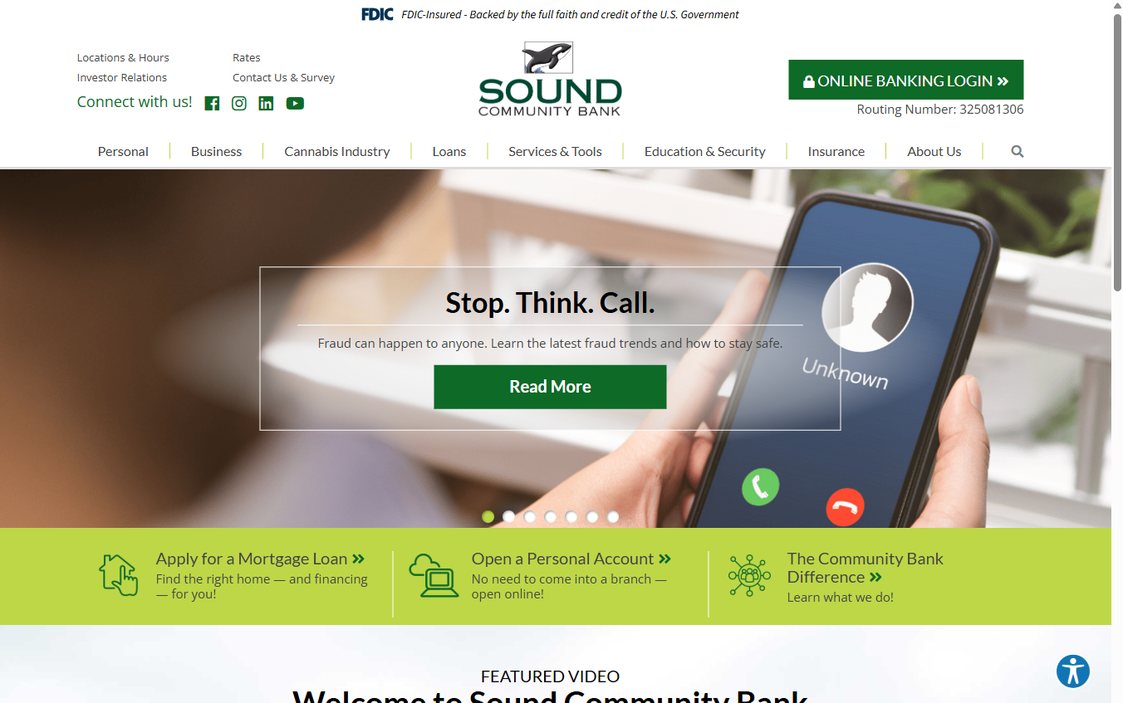
Sound Community Bank offers a conventional banking experience for those looking to purchase a manufactured home. They provide structured loans governed by a very clear set of requirements. This is a fantastic choice for buyers with established credit seeking the peace of mind that comes with an FDIC-insured institution.
Partnering with a bank like this provides a bedrock of stability. Because your funds are protected by the full faith and credit of the U.S. Government, you can navigate major life transitions without constant worry.
Their program follows specific parameters, including a 10% minimum down payment and a minimum FICO score of 640. With loan amounts reaching up to $350,000, they offer significant breathing room for those making a major investment in their future property.
Since this follows a “real property” approach, it is highly recommended for long-term residents. If you intend to stay put and build equity through traditional means, this is a sturdy path to follow.
Advantages:
- FDIC-insured under the full faith of the U.S. Government.
- Generous loan amounts up to $350,000.
- Highly predictable and clear lending criteria.
Disadvantages:
- Requires a minimum FICO score of 640.
4. Fannie Mae

Fannie Mae serves as the massive engine running behind the scenes of the entire American housing market. You won’t walk into a local branch to see them, but their technology and standards dictate how many loans are actually issued. They provide the essential framework that many professional lenders rely on to approve your application.
When a lender mentions they “follow Fannie Mae guidelines,” they are utilizing a standardized and highly regulated process. This systematic approach minimizes risk for both the bank and the borrower, creating a much more predictable landscape.
The Desktop Underwriter system is a cornerstone of the modern mortgage world. By leveraging advanced data and deep insights, they help lenders deliver faster and more accurate underwriting recommendations. This is the gold standard for anyone seeking highly regulated, standardized single-family financing.
This technology effectively reduces the “human error” factor in the approval process. The result is a clinical, predictable outcome for the borrower, which can significantly lower the anxiety typically associated with mortgage applications.
Advantages:
- Uses sophisticated Desktop Underwriter technology.
- Provides massive scale and market stability.
- Offers streamlined pricing via modern credit models.
Disadvantages:
- Not a direct lender; you must work through a partner.
Building a Strong Case for Your Loan Application
Landing a mortgage for a manufactured residence demands much more than a healthy credit rating. It is a marathon of paperwork, not a sprint. Because these properties are viewed through a different lens than traditional stick-built houses, banks tend to be quite scrutinizing when assessing your repayment capacity and the home’s actual worth as collateral.
You should begin by rounding up your “Big Three” essentials: income verification, tax filings, and records of your assets. When eyeing a manufactured home, expect lenders to demand at least a 24-month track record of steady employment. This level of continuity acts as a safety net, proving to the bank that you can keep up with payments for years to come.
For the self-employed crowd, the scrutiny often intensifies, digging deep into your actual cash flow. You might find yourself handing over several months of bank statements to demonstrate that your revenue isn’t just a temporary windfall. It is vital to show that your earnings remain steady through every season.
Additionally, keep a close watch on your debt-to-income (DTI) ratio to ensure it stays lean. Most financial institutions prefer that your total monthly debt liabilities stay under 43% of your gross monthly earnings. Keeping this number low is like clearing a hurdle before you even step onto the track.
Charting Your Course Toward a New Home
Many buyers stumble early by selecting an unsuitable financing structure for their specific residence. It is a bitter pill to swallow, but manufactured dwellings are frequently categorized differently than conventional stick-built houses. Pursuing a standard mortgage for a mobile home can lead you straight into a thicket of bureaucratic roadblocks and endless delays.
Before you even begin the formal paperwork, pull your lender aside and ask, “Will this be a real property mortgage or a chattel loan?” Getting this clarity upfront is like having a compass in a storm. It prevents weeks of unnecessary headaches and a mountain of useless documentation.
Don’t let the fine print catch you off guard, especially regarding your credit rating. Every institution has its own rules; for instance, Sound Community Bank maintains a strict minimum requirement for scores. If your rating is just a few points shy of their threshold, you might be spinning your wheels.
Consider the nuances of how these numbers impact your wallet. While a 640 score might grant you access at one bank, a 680 or better could open doors to much cheaper interest rates elsewhere. It pays to verify your exact standing and the specific metrics lenders use before signing anything.
Lastly, keep a hawk-eye on your credit profile and avoid last-minute checks. A sudden drop in your rating can transform a “yes” into a hard “no” in the blink of an eye. Even something as trivial as a high credit card balance or an unpaid medical bill can throw a wrench in the gears.
Give yourself the gift of preparation by tidying up your report and fixing any errors. You need to know exactly what you offer a lender before you begin your search. Think of a pristine, well-ordered credit history as your most powerful bargaining chip when negotiating your terms.
Leave a Reply